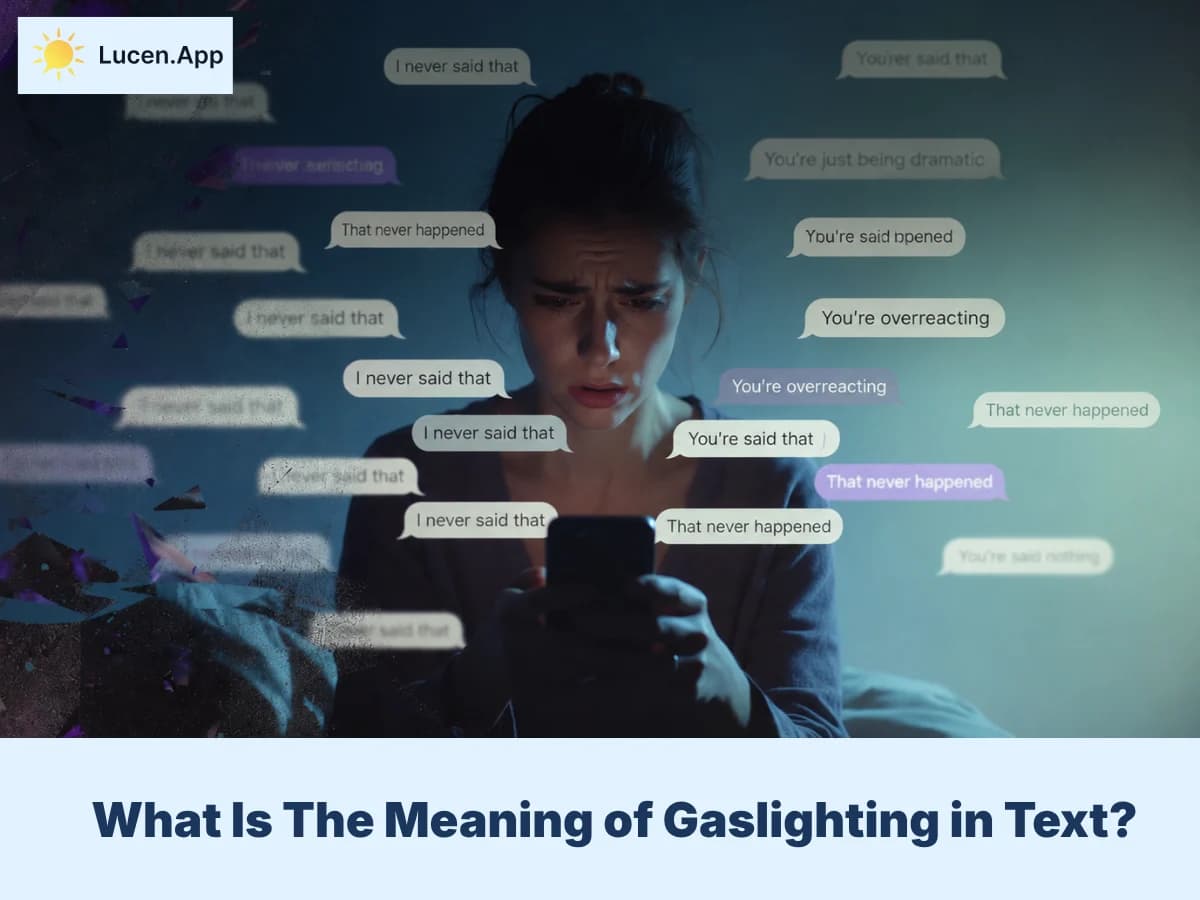
What Is The Meaning of Gaslighting in Text?
Gaslighting is a form of psychological and emotional abuse where a manipulator distorts the truth to make someone question their own memory, perception of reality, or sanity. Instead of resolving disagreements honestly, the gaslighter may deny conversations, rewrite past events, shift blame, dismiss emotions, or insist that the other person is remembering things incorrectly. These tactics create confusion and self-doubt, making it harder for the recipient to trust their own judgment and experiences.
In text conversations, gaslighting often appears through repeated patterns rather than a single message. Common signs include denying reality, minimizing feelings, using DARVO tactics, making someone doubt their memory, and creating chronic self-doubt. Over time, these messages can weaken self-confidence and distort a person's sense of reality. Recognizing gaslighting in texts is important because it helps identify emotional manipulation, establish healthy boundaries, and protect mental well-being in digital communication and relationships.
How to Identify Gaslighting in Text Conversation?
To identify gaslighting in text conversations, watch for signs such as denying your reality, rewriting past events, shifting blame, making you doubt your memory, and reversing victim and offender (DARVO). Also, pay attention to minimizing or trivializing your feelings, silent treatment or withholding communication, using others to validate their perspective, and creating chronic self-doubt. Repeated patterns that leave you questioning your memory, feelings, or judgment may indicate gaslighting.
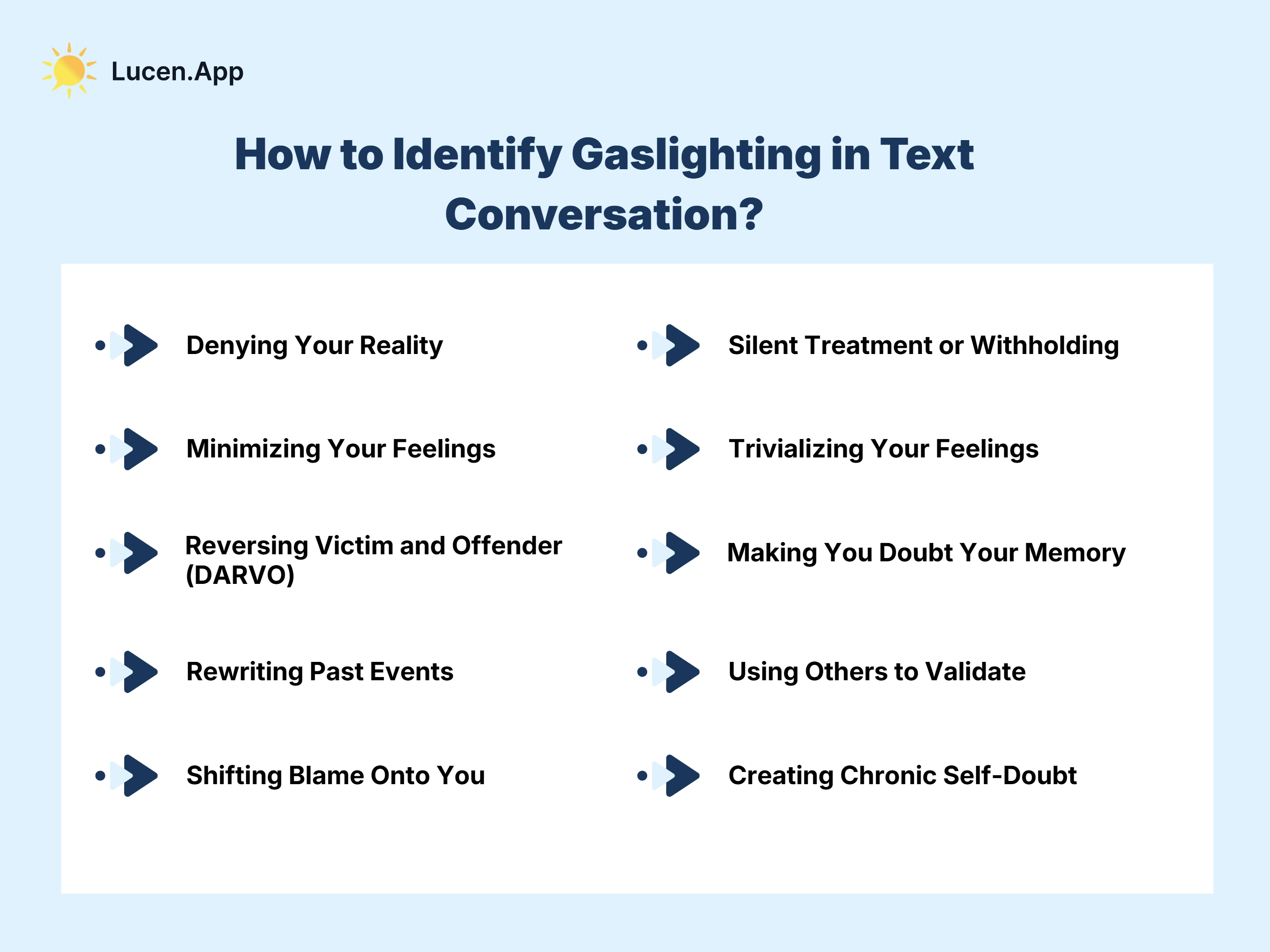
Here are 10 key signs of gaslighting in text conversations:
- Denying Your Reality
- Minimizing Your Feelings
- Reversing Victim and Offender (DARVO)
- Rewriting Past Events
- Shifting Blame Onto You
- Silent Treatment or Withholding
- Trivializing Your Feelings
- Making You Doubt Your Memory
- Using Others to Validate
- Creating Chronic Self-Doubt
Denying Your Reality
One of the clearest signs of gaslighting in text conversations is the denial of events, statements, or experiences that you know occurred. A gaslighter may send messages such as "I never said that" or "That never happened," even when screenshots prove otherwise. This tactic creates confusion, weakens trust in your memory, and shifts control of the narrative. Pay attention to repeated contradictions rather than isolated disagreements.
Minimizing Your Feelings
Emotional dismissal is a common gaslighting tactic used through text messages. Phrases like "You're overreacting," "You're too sensitive," or "It's not a big deal" reduce the importance of your feelings and concerns. Over time, these responses can make you question whether your emotional reactions are valid. If someone consistently minimizes your experience instead of addressing it, consider it a warning sign of manipulative communication.
Reversing Victim and Offender (DARVO)
The DARVO pattern is a strong indicator of gaslighting in digital communication. Instead of accepting responsibility, the person denies wrongdoing, attacks your concern, and presents themselves as the victim. Messages such as "Why are you attacking me?" or "I'm the one being hurt here" redirect attention away from their behavior. Recognizing this reversal helps you distinguish genuine accountability from manipulative blame-avoidance.
Rewriting Past Events
When identifying gaslighting in text conversations, pay attention to attempts to rewrite past events or alter the history of a conversation. A gaslighter may deny previous agreements, change details, or claim you misunderstood what was clearly stated. If a person's version of events regularly conflicts with message records, it may indicate a pattern of reality distortion rather than a simple misunderstanding.
Shifting Blame Onto You
Shifting blame is a common gaslighting tactic in text conversations that makes you feel responsible for problems you did not create. Instead of addressing their actions, the sender shifts focus to your reaction, framing you as the cause of the conflict. Texts such as "You made me do it" or "This wouldn't have happened if you didn't..." are common examples.
Silent Treatment or Withholding
Intentional silence can be a form of gaslighting when used to punish, control, or confuse. In text conversations, this may appear as ignored messages, unexplained communication gaps, or selective responses after conflict. While delayed replies happen naturally, a consistent pattern tied to disagreements often signals something different. Evaluate whether the silence is being used as a strategy to create anxiety and uncertainty.
Trivializing Your Feelings
Another sign of gaslighting is the tendency to make your concerns seem exaggerated or unreasonable. Messages such as "You're being dramatic," "Calm down," or "You can't take a joke" shift focus away from the issue and onto your reaction. This pattern discourages open communication and gradually reduces confidence in your emotional judgment. Repeated trivialization can be just as damaging as direct criticism.
Making You Doubt Your Memory
Making you doubt your memory is one of the most common signs of gaslighting in text conversations. A gaslighter may insist that you misunderstood messages, forgot details, or remembered events incorrectly. These repeated challenges can create confusion and weaken trust in your own judgment. If message records consistently conflict with their claims, consider whether the pattern reflects manipulation rather than a misunderstanding.
Using Others to Validate
Messages such as "Everyone agrees with me" or "Nobody else sees it that way" can function as a form of gaslighting, creating the impression that your viewpoint is isolated or unreasonable. Social validation becomes a manipulative tactic when someone repeatedly uses others to dismiss your perspective. This can increase self-doubt and weaken your confidence. Trust your own evidence and experience over claims about others.
Creating Chronic Self-Doubt
Gaslighting creates chronic self-doubt when repeated messages make you question your feelings, memory, and judgment. Notice whether you often reread texts, apologize without clarity, or rely on the sender to define what happened. This pattern signals emotional manipulation. Protect your mental health by documenting conversations, setting boundaries, and seeking support.
What Are Common Gaslighting Phrases Used in Texts?
Common gaslighting phrases used in texts include statements that deny your reality, make you doubt your memory, minimize your feelings, shift blame, reverse victim and offender roles, trivialize concerns, use others to validate a distorted version of events, and create self-doubt. These phrases are intended to undermine confidence in your perception, emotions, and judgment. Over time, repeated exposure to such messages can create confusion, weaken self-trust, and make emotional manipulation more difficult to recognize.
8 common types of gaslighting phrases used in texts are:
- Phrases that deny your reality
- Phrases that make you doubt your memory
- Phrases that minimize your feelings
- Phrases that shift the blame
- Phrases that reverse victim and offender (DARVO)
- Phrases that trivialize your concerns
- Phrases that use others to validate their version
- Phrases that create self-doubt and confusion
Phrases That Deny Your Reality
Some gaslighting messages work by directly rejecting your experience and replacing it with an alternative version of events. Whether they deny conversations, dispute facts, or question your perception, these statements can create uncertainty and make it harder to trust your own understanding of what happened.
Examples of phrases that invalidate your experiences include:
- "That never happened."
- "You're making things up."
- "You're imagining things."
- "That's not what I said."
- "You're remembering it wrong."
Phrases That Make You Doubt Your Memory
Phrases that make you doubt your memory are a common gaslighting tactic in text conversations. Statements that question your recollection, accuracy, or understanding can create confusion and self-doubt. Over time, repeated challenges to your memory may weaken confidence in your judgment and perception.
Below are phrases that may cause you to question your memory:
- "Your memory is terrible."
- "You always get the details wrong."
- "Are you sure that's what happened?"
- "I think you're confused."
- "You're mixing things up again."
Phrases That Minimize Your Feelings
When gaslighting occurs in text conversations, emotionally dismissive phrases are often used to undermine your confidence in your own feelings. These messages downplay legitimate concerns and frame your reaction as the problem. This tactic can create confusion and discourage you from expressing yourself openly.
Phrases that minimize your feelings are:
- "You're overreacting."
- "You're too sensitive."
- "It's not a big deal."
- "Why are you making this such a big issue?"
- "You're taking it too personally."
Phrases That Shift the Blame
In gaslighting text conversations, blame-shifting phrases are used to avoid responsibility and make you feel accountable for someone else's behavior. Rather than addressing their actions, the sender shifts the blame to you and treats your reaction as the problem. Over time, this tactic can create guilt, confusion, and persistent self-doubt.
Common blame-shifting phrases include:
- "This wouldn't happen if you didn't..."
- "You're the real problem here."
- "You made me do it."
- "Everything was fine until you brought it up."
- "You're always looking for problems."
Phrases That Reverse Victim and Offender (DARVO)
A common DARVO tactic in gaslighting text messages involves reversing the roles of victim and offender. When confronted, the sender denies wrongdoing, frames your concern as an attack, and presents themselves as the injured party. This manipulation can distract from the original issue and make you question whether your concerns were justified.
The phrases that reverse victim and offender (DARVO) are:
- "I'm the one being hurt here."
- "Why are you attacking me?"
- "You're being abusive."
- "I can't believe you're treating me like this."
- "After everything I've done for you."
Phrases That Trivialize Your Concerns
Some gaslighting messages work by dismissing concerns instead of addressing them. Rather than engaging with the issue, the sender frames your response as dramatic, irrational, or unnecessary. Repeated exposure to these statements can weaken confidence in your judgment and discourage you from speaking up.
Examples of phrases that trivialize your concerns are:
- "You're being dramatic."
- "You're making a mountain out of a molehill."
- "It's just a joke."
- "You can't take a joke."
- "You're acting crazy over nothing."
Phrases That Use Others to Validate Their Version
In gaslighting text conversations, some phrases use other people's opinions to make your perspective seem unreasonable or isolated. By claiming that everyone agrees with them, the sender creates social pressure and encourages self-doubt. This tactic can weaken confidence in your judgment and make you question your own experience.
Common phrases that use others to validate their version include:
- "Everyone agrees with me."
- "Nobody else sees it that way."
- "Ask anyone, and they'll tell you."
- "You're the only one who thinks that."
- "Other people don't have this problem."
Phrases That Create Self-Doubt and Confusion
Some gaslighting messages work by creating uncertainty about your perception of reality rather than directly denying it. These statements encourage you to second-guess your judgment, emotions, and understanding of situations. Repeated exposure to this tactic can leave you feeling confused, insecure, and increasingly dependent on external validation.
Below are phrases that create self-doubt and confusion:
- "Maybe you need help."
- "You sound paranoid."
- "You're not thinking clearly."
- "I don't know why you believe that."
- "You really need to work on yourself."
What Factors Make Gaslighting Over Text Hard to Recognize?
The factors that make gaslighting over text hard to recognize include a lack of nonverbal cues, plausible deniability, gradual manipulation, emotional attachment, mixed signals, existing self-doubt, message overload, and blame-shifting tactics. Together, these factors can disguise manipulative behavior and make harmful messages appear normal or justified.
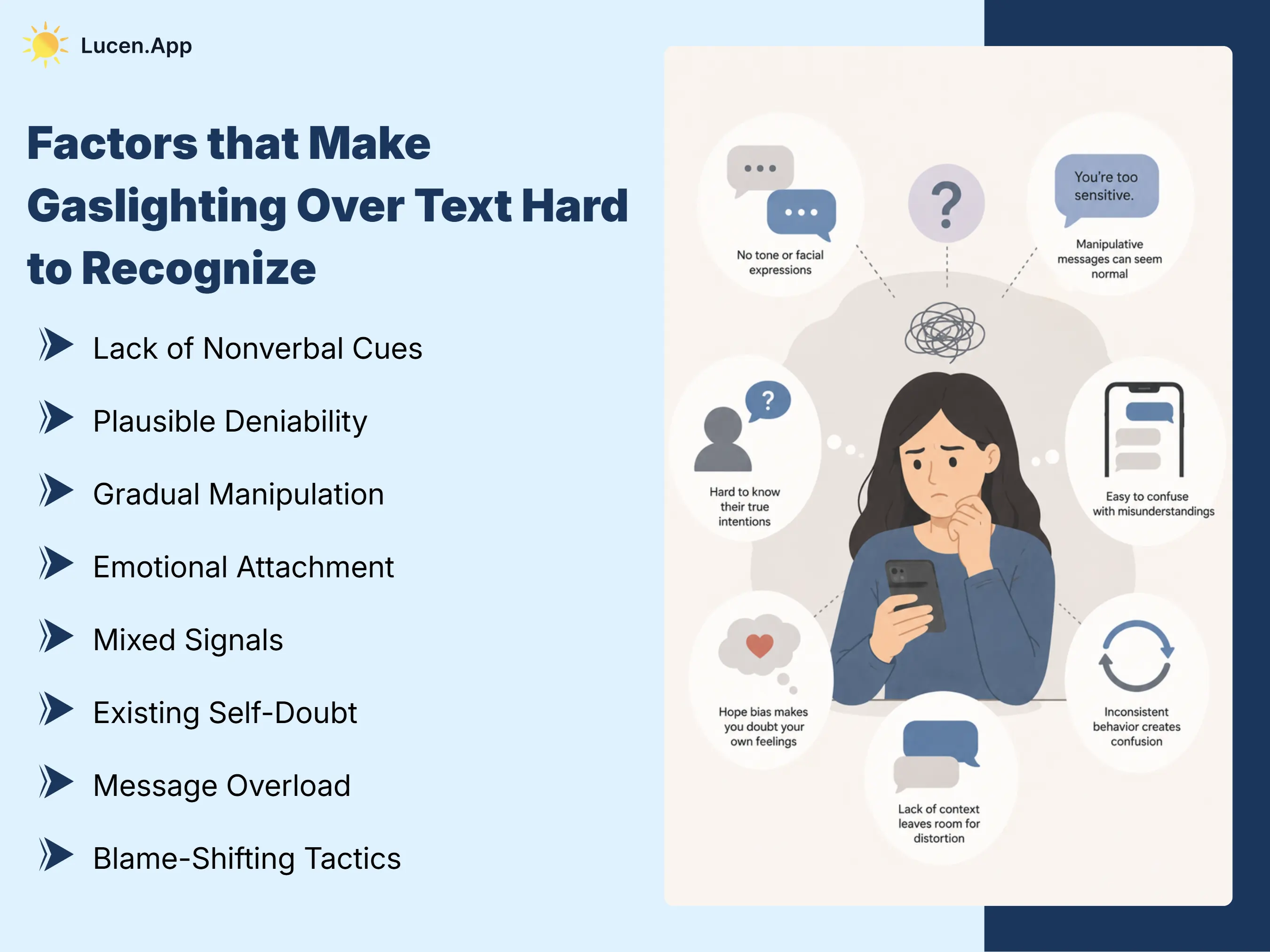
8 factors that make gaslighting over text hard to recognize are:
- Lack of Nonverbal Cues
- Plausible Deniability
- Gradual Manipulation
- Emotional Attachment
- Mixed Signals
- Existing Self-Doubt
- Message Overload
- Blame-Shifting Tactics
Lack of Nonverbal Cues
The absence of tone, facial expressions, and body language makes gaslighting over text harder to recognize. Without these nonverbal cues, messages can appear neutral even when they contain manipulation. This lack of context makes it more difficult to identify dismissive, deceptive, or reality-distorting communication.
Plausible Deniability
Plausible deniability makes gaslighting over text difficult to identify because the sender can easily deny intent or reinterpret their words. Claims such as "I was joking" or "You misunderstood" create uncertainty about what was actually meant. This confusion often causes recipients to question their own interpretation.
Gradual Manipulation
A slow and subtle progression of manipulative behavior makes gaslighting over text easy to overlook. Small contradictions, dismissive comments, and distortions of reality may seem insignificant on their own. Over time, however, these repeated interactions can undermine trust in memory, perception, and judgment.
Emotional Attachment
A strong emotional attachment can make gaslighting text messages seem less concerning than they actually are. Trust, affection, and a desire to preserve the relationship often encourage people to overlook warning signs. As a result, harmful communication patterns may be mistaken for misunderstandings or temporary conflicts.
Mixed Signals
Conflicting messages make gaslighting over text harder to recognize by creating uncertainty about the sender's intentions. Alternating between affection, criticism, reassurance, and blame can leave the recipient emotionally confused. This inconsistency often masks manipulation and makes harmful patterns more difficult to identify.
Existing Self-Doubt
Pre-existing self-doubt increases vulnerability to gaslighting in text conversations, as individuals who lack confidence in their judgment are more likely to trust the manipulator's version of events. They may accept distorted explanations, dismiss legitimate concerns, or second-guess their own perceptions. This reduced confidence can make emotional manipulation seem believable and harder to recognize.
Message Overload
An overwhelming volume of messages can conceal gaslighting behavior within everyday communication. When conversations become lengthy or constant, it becomes harder to identify contradictions, emotional pressure, or distortions of reality. This overload often prevents recipients from objectively evaluating what is being communicated.
Blame-Shifting Tactics
Repeated blame-shifting makes gaslighting over text difficult to recognize because attention is redirected away from the sender's behavior. Instead of addressing concerns, the conversation focuses on the recipient's reactions or perceived faults. This tactic creates guilt and confusion, making manipulation appear justified rather than harmful.
How Does Gaslighting Differ from Manipulation in Texts?
Gaslighting is a specific form of psychological manipulation that causes someone to question their memory, perception, or understanding of events, whereas manipulation is a broader tactic used to influence a person's emotions, decisions, or behavior. In text conversations, gaslighting often involves denying facts, rewriting events, or making someone doubt their reality, while manipulation may seek control without directly challenging their perception of what happened.
| Aspect | Gaslighting in Texts | Manipulation in Texts |
|---|---|---|
| Primary Goal | Make someone doubt their reality, memory, or perception | Influence emotions, decisions, or behavior |
| Common Tactics | Denial, reality distortion, rewriting events, questioning memory | Guilt-tripping, persuasion, emotional pressure, flattery |
| Impact on the Recipient | Creates confusion, self-doubt, and mistrust of personal judgment | Creates emotional pressure or encourages a specific response |
| Relationship to Reality | Directly challenges what the recipient believes happened | Does not necessarily dispute reality or facts |
| Example Text | "That never happened. You're remembering it wrong." | "After everything I've done for you, you should help me." |
| Long-Term Effect | Can weaken self-trust and increase dependence on the sender | Can influence choices without altering perception of reality |
| Type of Behavior | A specific form of psychological manipulation | A broader category of influence and control tactics |
How Should You Respond to Gaslighting in Texts?
You should respond to gaslighting in texts by keeping your responses calm and neutral, asking clarifying questions, saving messages and screenshots, addressing the pattern, setting clear boundaries, seeking outside support, and trusting your own reality. These steps can help you stay grounded in facts, protect your emotional well-being, and recognize manipulation without becoming drawn into arguments that distort your perception of events.
The following approaches can help you handle gaslighting more effectively:
- Respond calmly and focus on facts rather than emotions.
- Request specific explanations to identify contradictions and inconsistencies.
- Keep records of conversations to verify events and protect your reality.
- Point out repeated inconsistencies when it is safe and appropriate to do so.
- Limit conversations that involve denial, blame, or emotional manipulation.
- Talk to trusted friends, family members, or a mental health professional.
- Rely on evidence and documented conversations rather than repeated denials.
Why Can't You Reason to Gaslighting?
You cannot effectively reason with gaslighting because the goal is not to reach understanding but to distort your perception of reality. A gaslighter may deny facts, rewrite events, or question your memory, even when clear evidence exists. This behavior shifts the conversation away from logic and toward confusion and self-doubt. Recognizing gaslighting as manipulation rather than a genuine disagreement can help you protect your judgment, boundaries, and emotional well-being.
How Can You Use AI to Detect and Respond to Gaslighting in Texts?
You can use AI to detect gaslighting in texts by analyzing conversations for patterns such as denial, blame-shifting, distortion of reality, contradictory statements, and attempts to rewrite past events. AI tools can identify recurring language that may cause someone to question their memory, feelings, or perception of reality. By highlighting these red flags, AI helps users recognize potentially manipulative communication that might otherwise go unnoticed.
Beyond detection, AI can support more effective responses to gaslighting in text conversations. A chat analyzer can summarize message patterns, organize conversation records, and suggest calm, boundary-focused replies. While AI cannot determine intent or diagnose emotional abuse, it can provide objective insights that help users document concerns, maintain clarity, and make informed decisions about their digital interactions.