A situationship is an undefined romantic or emotional connection that exists without clear labels, commitment, exclusivity, or long-term relationship direction. Key characteristics of a situationship include inconsistent communication, emotional ambiguity, lack of future planning, limited integration into each other’s lives, and physical intimacy without emotional accountability. Unlike committed relationships, situationships often create emotional closeness while still leaving both people uncertain about boundaries, expectations, and relationship status.
Common types of situationships include the talking stage, almost-relationship, emotional situationship, convenience situationship, placeholder situationship, friends with benefits (FWB), and transactional situationship. People often enter situationships because of fear of commitment, loneliness, emotional comfort, dating-app culture, or the hope that the relationship will eventually become serious.
While situationships can provide companionship, flexibility, self-awareness, and emotional growth, they can also lead to anxiety, mixed signals, insecurity, emotional exhaustion, and one-sided emotional investment. Handling a situationship in a healthy way requires honest communication, clear boundaries, emotional self-awareness, and realistic expectations about the relationship's future.
What Are the Key Characteristics of a Situationship?
Key characteristics of a situationship include a lack of clear labels, inconsistent communication, a lack of future planning, a lack of emotional commitment, ambiguity, and limited integration. These characteristics create a relationship dynamic that feels emotionally close at times, yet lacks the structure, clarity, and commitment found in traditional relationships.
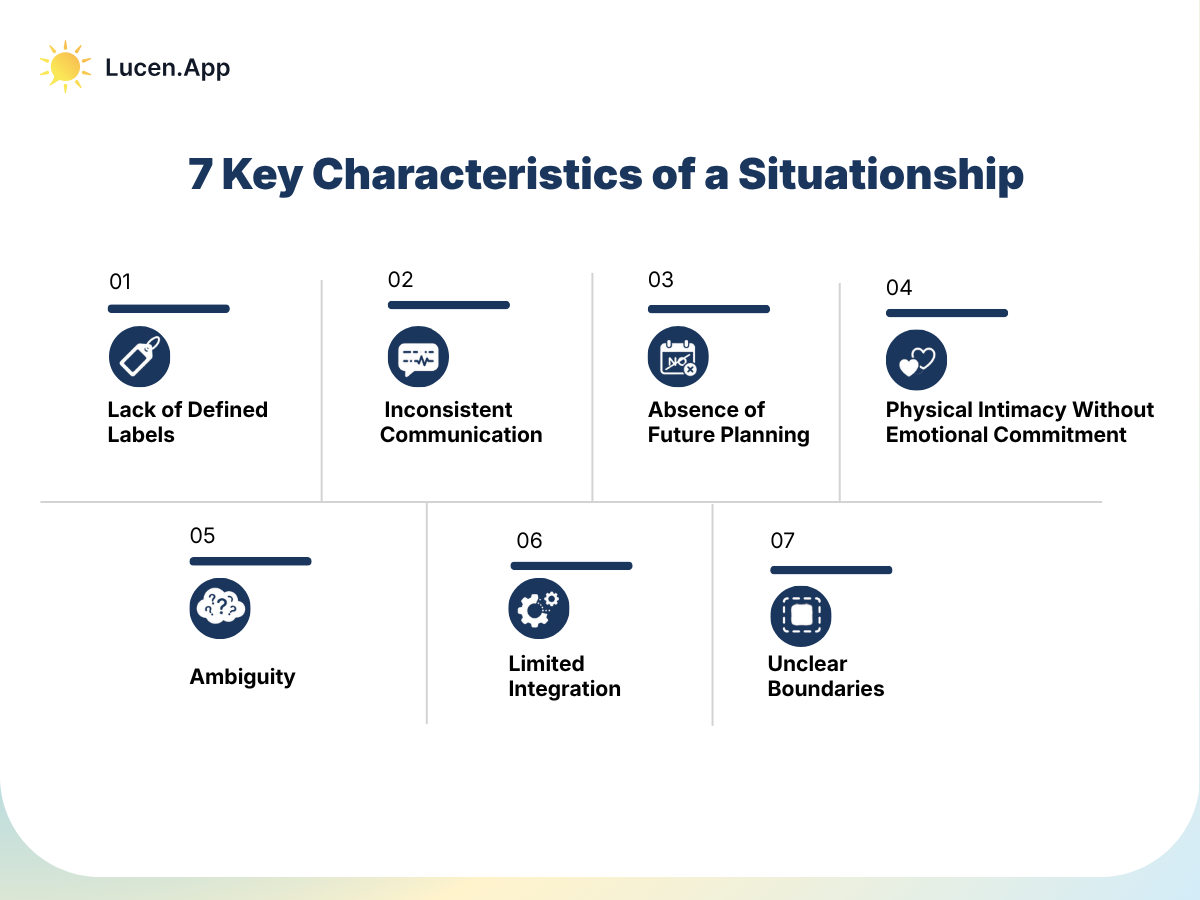
Below are the 7 key characteristics of a situationship:
Lack of Defined Labels
In a situationship, there is often a deliberate avoidance of labels such as “boyfriend,” “girlfriend,” or “partner.” The define-the-relationship conversation (DTR) is postponed, dismissed, or redirected with phrases like “let’s just see where things go.” This absence of a formal definition keeps the relationship ambiguous and prevents clear expectations from forming. Without labels, neither person fully understands the level of commitment, exclusivity, or emotional responsibility attached to the connection, which separates a situationship from traditional romantic relationships where intentions are communicated openly.
Inconsistent Communication
Communication in a situationship is unpredictable and inconsistent. One person may communicate intensely for several days through texting, calls, or late-night conversations, then suddenly become distant or unavailable. Contact often happens only when convenient, rather than through steady emotional engagement. This inconsistency creates mixed signals and emotional instability because there are no agreed-upon boundaries or expectations for communication. In committed relationships, consistent communication helps build trust, emotional security, and reliability, while situationships often leave people feeling anxious or uncertain about where they stand.
Absence of Future Planning
Situationships rarely involve meaningful discussions about the future. Plans are limited to immediate or short-term situations, such as meeting later that night instead of planning vacations, holidays, or long-term goals together. Conversations about compatibility, exclusivity, or shared life direction are often avoided because future planning implies commitment and emotional progression. This keeps the relationship suspended in the present moment without a defined trajectory. Over time, the absence of future planning reinforces emotional uncertainty and prevents deeper integration into each other’s lives.
Physical Intimacy Without Emotional Commitment
The physical chemistry is intense and undeniable, yet it exists entirely in isolation, unanchored by emotional intimacy or any sense of mutual safety. Partners may share romantic or sexual experiences that resemble a real relationship while still avoiding emotional vulnerability, accountability, or dependable support. The connection can feel intense during moments of intimacy, but emotional distance frequently returns afterward. This imbalance creates confusion because physical closeness may stimulate attachment and emotional investment without providing the emotional safety or stability associated with committed relationships.
Ambiguity
Ambiguity is the defining feature of most situationships, where uncertainty is not confined to the early stages of dating but becomes the ongoing emotional environment of the relationship. Neither person clearly communicates expectations, exclusivity, or long-term intentions, leaving both individuals to interpret signals on their own. This unclear dynamic often creates chronic anxiety, overthinking, and emotional hesitation because expressing needs or asking for clarity may feel risky. The constant lack of certainty keeps the relationship emotionally unstable and difficult to define.
Limited Integration
People in a situationship rarely become fully integrated into each other’s everyday lives or social circles. Introductions to close friends, family members, coworkers, or important events are uncommon. Invitations to weddings, holidays, family dinners, or public gatherings may never happen because the relationship remains compartmentalized and unofficial. This limited integration creates emotional distance and allows the connection to be easily exited without social accountability or explanation.
Unclear Boundaries
Boundaries surrounding exclusivity, emotional support, communication etiquette, and relationship expectations are often left undefined in a situationship. Without direct conversations, one person may assume emotional exclusivity while the other continues to date multiple people or use dating apps. The lack of transparent communication creates misunderstandings, one-sided expectations, and emotional insecurity. Because there are no clearly established boundaries, both individuals remain uncertain about what behaviors are acceptable and what level of commitment truly exists within the connection.
What Are the Different Types of Situationships?
The different types of situationships are the talking stage, the almost-relationship, the emotional situationship, the convenience situationship, the placeholder situationship, friends with benefits (FWB), and the transactional situationship. Each type of situationship develops under different emotional, social, or personal circumstances, yet all of them share the characteristic of a relationship that exists without fully defined commitment, clear boundaries, or long-term certainty.
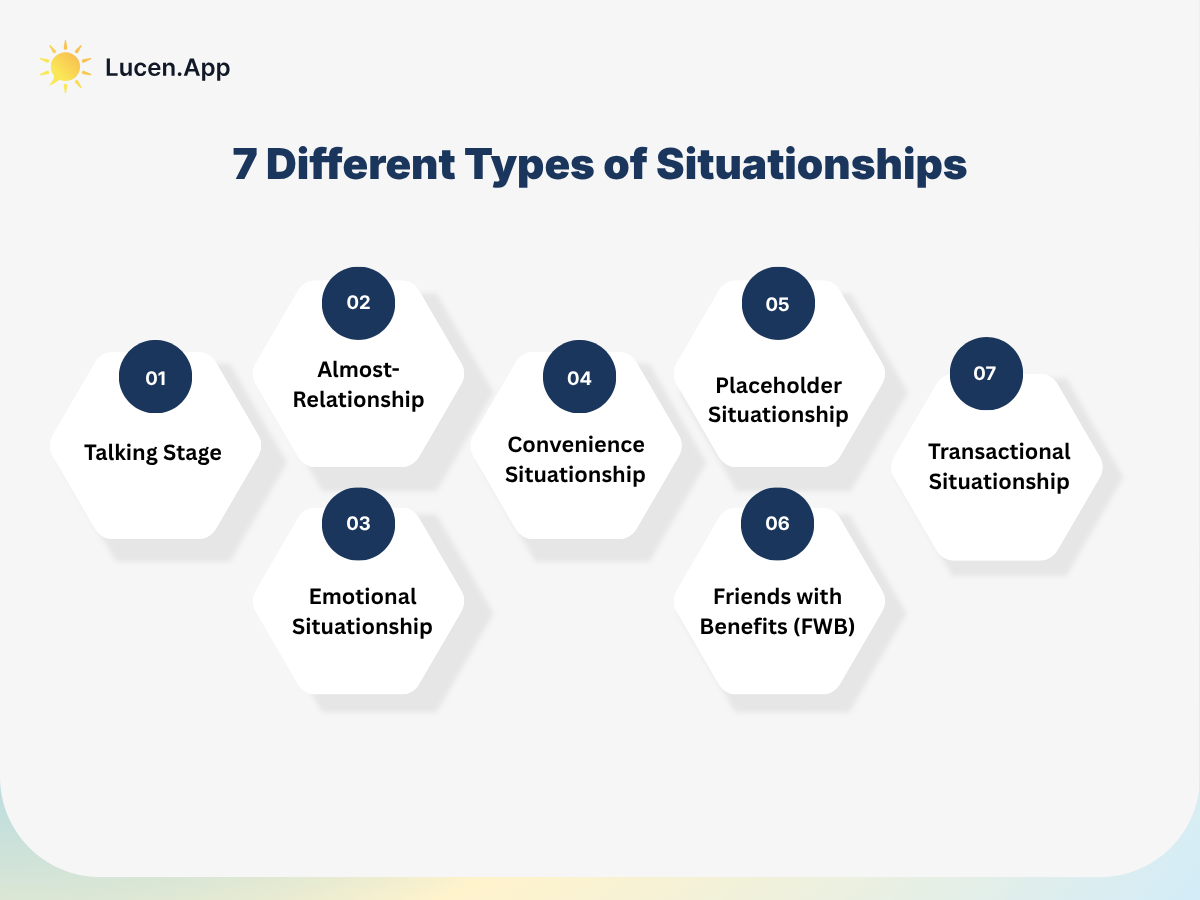
7 types of situationships are:
Talking Stage
A talking stage situationship is a type of situationship that develops when two people communicate consistently, flirt regularly, and build romantic interest without officially entering a relationship. This dynamic occurs through dating apps, social media interactions, or early dating experiences, in which both individuals are still exploring attraction and compatibility while avoiding commitment or exclusivity.
The connection may involve texting, emotional engagement, casual dates, and romantic attention, yet neither person initiates the conversation to define the relationship. A major benefit of the talking stage in a situationship is that it allows both individuals to gradually identify communication styles, boundaries, and compatibility without immediate relationship pressure.
Almost-Relationship
Unlike the talking stage, an almost-relationship situationship is a part of situationship that closely resembles a traditional romantic relationship but never becomes officially defined. Both people may spend significant time together, communicate daily, share emotional intimacy, and behave like romantic partners, all while avoiding labels or commitment.
It often develops when one person fears vulnerability, emotional dependence, or long-term commitment despite maintaining strong feelings for the other person. One benefit of an almost-relationship is the emotional closeness and companionship it provides without the responsibilities of a fully committed relationship, though the lack of clarity often creates emotional confusion and anxiety over time.
Emotional Situationship
An emotional situationship focuses primarily on emotional intimacy instead of physical intimacy. Within this type of situation, two people may communicate constantly, support each other emotionally, discuss personal struggles, and form a deep attachment while still avoiding romantic labels, exclusivity, or commitment.
Such an arrangement commonly develops between close friends, coworkers, long-distance connections, or individuals recovering from past relationship trauma. This situationship offers comfort, validation, and companionship during emotionally difficult periods, although uneven emotional investment can eventually create misunderstanding or heartbreak.
Convenience Situationship
A convenience situationship is a type of situationship that often develops because the relationship easily fits into both individuals’ routines, lifestyles, or environments. The connection may continue because of proximity, loneliness, familiarity, shared schedules, or social convenience rather than strong romantic compatibility.
Examples include coworkers spending time together after work, classmates consistently connecting, or neighbors casually developing romantic habits over time. One benefit of a convenience situationship is that it provides low-pressure companionship and intimacy during transitional life phases without requiring significant emotional or long-term commitment.
Placeholder Situationship
Placeholder situationship occurs when one person maintains the relationship temporarily while waiting for emotional clarity, another romantic opportunity, or personal healing. During this situationship, the connection often continues because it provides attention, emotional support, intimacy, or validation without genuine long-term intention.
It commonly develops after breakups, during periods of loneliness, or when someone fears being alone but remains emotionally unavailable. A short-term benefit of this situation is emotional companionship during unstable life periods, although the relationship can become highly one-sided if one person develops a serious emotional attachment while the other continues treating the connection as temporary.
Friends with Benefits (FWB)
A friends-with-benefits situation combines friendship with ongoing physical intimacy while intentionally avoiding romantic commitment or exclusivity. Both individuals agree to maintain a casual arrangement centered around a sexual connection without traditional relationship expectations.
FWB commonly develops between existing friends, former romantic partners, or people who prioritize physical compatibility without wanting a committed relationship. One benefit of an FWB arrangement is the combination of companionship and physical intimacy without the pressure of long-term planning or emotional obligation, although emotional attachment can still develop unexpectedly over time.
Transactional Situationship
A transactional situationship develops when the relationship is maintained primarily through mutual benefit, convenience, or exchange rather than emotional connection alone. One person may provide emotional support, gifts, financial assistance, attention, social access, or career opportunities while receiving companionship, intimacy, validation, or status in return.
It occurs in professional environments, online relationships, or emotionally imbalanced dynamics where practical value becomes the foundation of the connection. A major benefit of a transactional situationship is that expectations may remain more practical and emotionally controlled than in highly romantic relationships, although emotional complications often arise when one person starts expecting genuine commitment outside the original arrangement.
How Is a Situationship Different from a Relationship, Casual Dating, and Friends with Benefits?
A situationship is a romantic or emotional connection that exists without clear commitment, defined labels, or long-term certainty, whereas a relationship involves mutual commitment, relational security, and openly discussed expectations. Casual dating focuses on low-pressure romantic interaction without immediate exclusivity, while friends with benefits primarily centers around physical intimacy between friends without romantic expectations.
Although these relationship dynamics may overlap in certain situations, the biggest difference lies in clarity, emotional accountability, exclusivity, and future intention.
| Aspect | Situationship | Relationship | Casual Dating | Friends with Benefits (FWB) |
|---|---|---|---|---|
| Definition | An undefined romantic or emotional connection without clear commitment | A committed romantic partnership with defined expectations | A low-pressure dating dynamic focused on getting to know someone | A friendship combined with physical intimacy without romantic commitment |
| Commitment | Commitment remains unclear or inconsistent | Mutual commitment and emotional accountability are established | Limited or flexible commitment | No expectation of romantic commitment |
| Communication | Often inconsistent or hot-and-cold | More stable, reliable, and emotionally secure | Casual and flexible communication patterns | Communication mainly revolves around convenience or physical connection |
| Future Planning | Rarely involves long-term planning or shared goals | Includes future discussions, life planning, and progression | Focuses mostly on the present without serious long-term expectations | Future planning is absent |
| Primary Focus | Emotional and physical connection without clarity | Emotional partnership, trust, and long-term compatibility | Exploring attraction and compatibility casually | Physical intimacy and companionship |
Why Do People Enter Situationships?
People enter situationships for emotional comfort, physical intimacy, convenience, fear of commitment, or uncertainty about what they want from a relationship. In many cases, the connection begins casually and gradually becomes emotionally involved without clear boundaries or expectations.
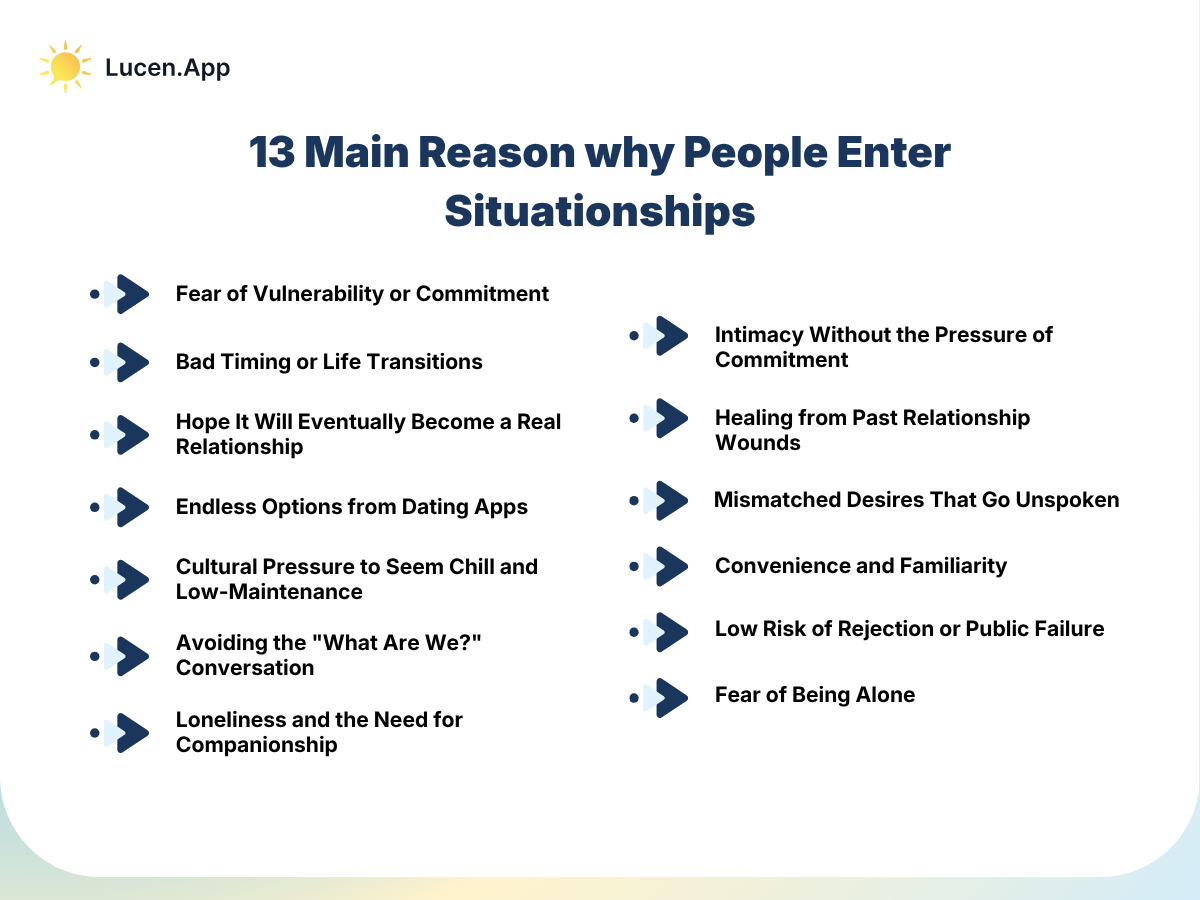
Here are the 13 main reasons why people enter situationships:
- Fear of Vulnerability or Commitment: Some individuals choose situationships because committed relationships require emotional vulnerability and deeper accountability. A situationship creates emotional closeness while still allowing both people to maintain enough distance to avoid the fear of heartbreak, rejection, or long-term emotional exposure.
- Bad Timing or Life Transitions: Major life transitions often push people toward situationships instead of committed relationships. Career pressure, college, relocation, emotional instability, or personal uncertainty may leave someone wanting companionship without fully integrating another person into their long-term plans.
- Hope It Will Eventually Become a Real Relationship: Many situationships continue because one person believes the connection will naturally evolve into a committed relationship over time. Emotional consistency, loyalty, and patience may feel like ways to eventually earn exclusivity or a deeper commitment from the other person.
- Endless Options from Dating Apps: The constant availability of romantic options through dating apps encourages many people to stay in undefined relationships. Some individuals want emotional attention and companionship while still keeping their options open in case another connection appears more attractive or compatible.
- Cultural Pressure to Seem Chill and Low-Maintenance: Modern dating culture often rewards emotional detachment and discourages the open expression of emotional needs too early, which leads people to situationship. Many people suppress their expectations or attachment because they fear being labeled clingy, needy, or overly invested.
- Avoiding the "What Are We?" Conversation: Fear of confrontation keeps many situationships emotionally stagnant. Defining the relationship conversation introduces vulnerability and the possibility of rejection, so some individuals avoid clarifying the relationship altogether, fearing that honesty could end the connection.
- Loneliness and the Need for Companionship: Emotional and physical companionship can temporarily ease feelings of loneliness and isolation, leading people to situationship. Having someone to text, spend time with, or connect with emotionally may feel comforting even when the relationship lacks stability, commitment, or long-term direction.
- Intimacy Without the Pressure of Commitment: For some individuals, situationships offer access to romance, physical intimacy, and emotional warmth without the responsibilities of committed relationships. The arrangement allows connection while avoiding accountability, compromise, or long-term expectations.
- Healing from Past Relationship Wounds: Previous heartbreak, betrayal, trauma, or emotionally toxic relationships can make commitment feel emotionally unsafe, making situationship an ideal option. A situationship may feel like a lower-pressure environment where someone can reconnect with intimacy gradually without immediately risking deeper emotional attachment.
- Mismatched Desires That Go Unspoken: Many situationships form because both individuals want different outcomes, but never communicate those differences honestly. One person may want commitment while the other prefers something casual, yet the relationship continues because neither side addresses the mismatch directly.
- Convenience and Familiarity: Familiar connections often feel easier and emotionally safer than building a completely new relationship, which can lead to a situationship. Situationships frequently develop between coworkers, longtime friends, classmates, ex-partners, or people within the same social circle because emotional access and comfort already exist.
- Low Risk of Rejection or Public Failure: Undefined relationships can feel emotionally safer than official relationships because they involve less visible accountability. Without labels, public announcements, or formal commitment, some people believe they can avoid the emotional pressure and social discomfort associated with breakups.
- Fear of Being Alone: For many individuals, emotional uncertainty feels less painful than complete emotional isolation. People with anxious attachment patterns may tolerate inconsistency, ambiguity, or mixed signals because unstable attention still feels emotionally safer than facing loneliness alone.
The 12 Signs You Are in a Situationship
Situationships tend to follow a recognizable pattern, marked by no clear label, last-minute planning, not being integrated into their lives, no future plans, inconsistent communication, no progression, lack of emotional connection, and inconsistent effort. These signs appear when emotional intimacy exists without clear commitment, exclusivity, or a clear direction for the relationship.
12 common signs that define a situationship are:
- No clear label or definition of the relationship: The absence of a clear relationship label often signals a situationship since emotionally committed relationships involve open conversations about exclusivity, intentions, and boundaries. If every attempt to define the relationship is avoided, delayed, or brushed aside, the connection remains emotionally unclear rather than secure.
- Last-Minute/Short-Term Planning: Constant last-minute planning reflects a situationship dynamic where convenience takes priority over intentional emotional investment. If interactions mostly revolve around spontaneous meetups or late-night texts without consistent planning, the relationship may lack serious commitment or long-term consideration.
- Not integrated into their life: Limited integration into someone’s personal life is a strong sign of a situationship because emotionally serious relationships naturally involve deeper social connection over time. If you rarely meet their close friends, family members, coworkers, or attend important events together, the relationship may be intentionally compartmentalized to avoid accountability or progression.
- No future talks: Avoiding conversations about the future often indicates the relationship is not progressing beyond an undefined stage. Healthy relationships naturally involve discussions about compatibility, exclusivity, goals, and shared plans, whereas situationships tend to focus only on the present moment.
- Communication is inconsistent or hot-and-cold: Hot-and-cold communication patterns frequently appear in situationships where emotional availability changes unpredictably. Intense attention followed by sudden distance creates mixed signals and emotional uncertainty instead of a stable emotional connection.
- Emotional ambiguity: Emotional ambiguity signals a situationship because the relationship constantly sends mixed emotional messages without providing clarity or emotional security. The connection may feel deeply romantic in private moments, yet remain emotionally distant during serious conversations about commitment or expectations.
- No Growth or Progression: Relationships grow through increased trust, commitment, communication, and emotional closeness over time. If the connection feels emotionally repetitive or trapped in the same undefined stage for months without meaningful progression, the situationship may already be stagnant.
- Feeling Anxious or Confused: Persistent anxiety or emotional confusion can indicate that the relationship lacks clarity and stability. Constantly overthinking texts, questioning intentions, or feeling uncertain about your position in someone’s life often reflects the emotional unpredictability common in situationships.
- Physical without emotional connection: Physical intimacy without emotional depth is a sign of a situationship, as the relationship prioritizes attraction and convenience over an emotional partnership or accountability. If emotional closeness disappears outside romantic or sexual moments, the connection may lack the vulnerability and support found in committed relationships.
- Avoiding Official Labels: Repeatedly avoiding labels or commitment conversations often shows that one or both individuals want to keep the relationship undefined. Official labels introduce accountability, exclusivity, and emotional responsibility, which situationships frequently avoid.
- One-sided effort and investment: An imbalance in emotional effort commonly appears in situationships where one person becomes significantly more invested than the other. If one side consistently initiates communication, plans, or emotional support while the other remains passive, the relationship may already be emotionally unequal.
- Inconsistent Effort: Inconsistent effort is a sign of a situationship because emotional attention and affection appear unpredictably rather than consistently. One week may feel emotionally intense and connected, while the next feels distant or detached, creating confusion instead of emotional security or stability.
How Can You Spot Red Flags in Situationship Conversations?
You can spot red flags in situationship conversations if your communication pattern avoids future plans, lacks direct emotional clarity, revolves around late-night-only interaction, creates emotional confusion, and shows inconsistent effort or investment. In healthy relationships, conversations create reassurance, emotional security, and clear expectations, while situationship conversations often leave one person questioning where they stand emotionally.
Spotting red flags in situationship conversations comes down to recognizing these 7 primary patterns:
- Avoids future plans: A partner avoids making plans for upcoming weekends, holidays, trips, or important events, which often signals a lack of long-term intention or emotional investment.
- Late-night-only communication: Most conversations happen late at night or only when convenient, showing that the connection may revolve more around temporary attention or physical intimacy than emotional commitment.
- Refusal to define the relationship: Direct conversations about exclusivity, labels, or commitment are avoided, delayed, or redirected, keeping the relationship emotionally ambiguous.
- Lack of direct communication: Conversations remain vague or passive-aggressive rather than emotionally honest, making boundaries and expectations difficult to understand.
- Surface-level conversations: Most interactions focus on casual topics, while deeper emotional discussions are avoided, preventing stronger emotional intimacy from developing.
- Treats you like an option: One person regularly feels emotionally secondary or replaceable instead of prioritized, which often creates anxiety and emotional insecurity.
- One-sided initiation: One person consistently starts conversations, makes plans, or checks in emotionally while the other contributes minimal effort, reflecting unequal emotional investment.
How Do You Know If Your Situationship Is One-Sided?
You can tell if your situationship is one-sided when one person becomes emotionally invested, emotionally available, and relationship-oriented, while the other remains inconsistent, emotionally distant, or unwilling to move the connection forward. Instead of feeling emotionally mutual and secure, the relationship starts to revolve around unequal effort, unclear expectations, and emotional imbalance, where one person consistently gives more time, energy, communication, and emotional investment than the other.
Here are common situations where there is a high chance the situationship has become one-sided:
- You always initiate communication
- You prioritize them more than they prioritize you
- You want commitment, while they avoid clarity
- You feel anxious when they disappear
- You know details about their life, but they know little about yours
- You constantly justify their behavior
What Are the Emotional Impacts of Being in a Situationship?
The emotional impacts of a situationship include positive effects such as self-awareness, emotional clarity, communication growth, confidence boosts, and companionship, as well as negative effects such as jealousy, chronic anxiety, and emotional confusion. Since situationships often exist without clear commitment or emotional stability, they can affect mental health, self-worth, attachment patterns, and emotional well-being.
10 Potential Positive Emotional Impacts of being in a Situationship include:
- Self-awareness about what you actually want: Situationships can help people more clearly identify their emotional needs, attachment style, relationship priorities, and expectations for long-term compatibility.
- Clarity on dealbreakers and boundaries: Experiencing emotional ambiguity in situationship may teach someone which behaviors, communication patterns, or relationship dynamics they no longer want to tolerate in future relationships.
- Growth in communication skills: Navigating unclear emotional dynamics in situationships often encourages stronger communication, emotional honesty, and boundary-setting over time.
- Confidence boost from being desired: Romantic attention, attraction, and emotional validation may temporarily improve confidence, desirability, or self-image for some individuals.
- Comfort and companionship during lonely periods: Situationships can provide emotional connection, physical intimacy, and social interaction during emotionally isolated or transitional periods in life.
- Freedom from relationship pressure: Some people appreciate the flexibility and low-pressure nature of situationships, especially when they are not emotionally ready for long-term commitment.
- Healing space after a past breakup: A lower-pressure emotional connection may help someone reconnect with intimacy gradually after experiencing heartbreak, betrayal, or emotionally toxic relationships.
- Excitement and novelty: The unpredictability, attraction, and emotional intensity in situationships may evoke excitement, passion, or emotional stimulation.
- Learning to sit with uncertainty: Some individuals develop stronger emotional awareness and resilience by learning how uncertainty affects their emotional reactions and attachment behaviors.
- Stronger sense of independence: Situationships may encourage emotional independence since individuals often maintain separate routines, goals, friendships, and personal identities outside the relationship.
12 Negative Emotional Impacts of being in a Situationship are:
- Jealousy you cannot express: Emotional jealousy often develops when one person wants exclusivity but feels unable to communicate those feelings openly because of the relationship's undefined nature.
- Chronic anxiety from uncertainty: Constant uncertainty about commitment, emotional intentions, or relationship progression can create long-term emotional stress and anxious attachment behaviors.
- Lowered self-esteem and self-worth: Repeated emotional inconsistency, mixed signals, or feeling emotionally secondary can gradually erode confidence and self-worth.
- Feelings of rejection without a clear cause: Situationships often lead to emotional rejection without direct explanation, because communication and expectations remain unclear.
- Emotional exhaustion from overthinking: Constantly analyzing texts, emotional behavior, social media activity, or mixed signals can become mentally draining and emotionally exhausting.
- Loneliness even while connected to someone: Emotional intimacy may still feel incomplete or emotionally distant despite regular communication, physical intimacy, or companionship.
- Confusion about where you stand: Unclear boundaries and inconsistent commitment often leave people emotionally unsure of their role or importance in the other person’s life.
- Hypervigilance over texts and behavior: Many people become emotionally hyperaware of response times, tone changes, emotional shifts, or behavioral inconsistencies due to relationship uncertainty.
- Suppressed needs and unspoken feelings: Fear of appearing needy, emotional, or demanding may prevent someone from expressing valid emotional needs or relationship expectations honestly.
- Resentment toward the other person: Emotional imbalance, inconsistent effort, or a lack of commitment can gradually create frustration and resentment within the relationship.
- Insecurity and self-doubt: Repeated emotional ambiguity may cause someone to question their value, attractiveness, emotional worth, or relationship expectations.
- Fear of asking for more: Many people avoid asking for exclusivity, emotional clarity, or commitment because they fear rejection, emotional withdrawal, or the loss of the relationship entirely.
What Are the Pros and Cons of a Situationship?
Situationships can offer low pressure, emotional flexibility, companionship, personal freedom, physical intimacy, and space for self-discovery, but the emotional confusion, insecurity, lack of commitment, mixed signals, and jealousy they often breed can accumulate into long-term emotional stress. Being aware of these pros and cons of a situationship can help you understand whether the connection is emotionally healthy, emotionally temporary, or slowly becoming emotionally harmful over time
Pros of a Situationship
- Low pressure and flexible: Situationships involve fewer expectations and responsibilities than committed relationships, which can make the connection feel emotionally lighter and easier to maintain.
- Freedom to focus on career, school, or personal goals: A lack of serious commitment may allow individuals to prioritize education, work, healing, travel, or personal growth without fully balancing relationship responsibilities.
- Companionship without full commitment: Situationships can still provide emotional support, attention, and social connection without requiring exclusivity or long-term planning.
- Physical and emotional intimacy available: Many situationships allow people to experience romance, affection, emotional closeness, or sexual intimacy while maintaining personal independence.
- Easy to exit without messy breakup: Since the relationship remains unofficial, ending the connection may sometimes feel less complicated than ending a deeply integrated, committed relationship.
- Less emotional risk upfront: Some individuals feel emotionally safer entering situationships because the relationship begins with fewer expectations and less immediate vulnerability.
- No need to meet family or integrate lives: Situationships avoid deeper social integration, which can feel emotionally easier for individuals who are not ready for serious commitment.
- Room to figure out what you actually want: Experiencing an undefined relationship may help individuals clarify their emotional needs, deal-breakers, boundaries, and long-term relationship preferences.
- Can feel exciting and spontaneous: The unpredictability, emotional intensity, and casual nature of situationships may evoke excitement, novelty, and emotional stimulation.
- No relationship labels or expectations to manage: Some individuals prefer to avoid the emotional pressure, responsibilities, or social expectations associated with official relationship labels.
- Useful during transitional life phases: Situationships may feel practical during emotionally unstable periods such as moving, healing after breakups, career transitions, or major lifestyle changes.
- Allows dating multiple people if both agree: In some situations, both individuals openly maintain non-exclusive dating arrangements, allowing greater personal freedom and flexibility.
Cons of a Situationship
- Emotional confusion and mixed signals: Situationships often create uncertainty because emotional intimacy exists without clear commitment, making it difficult to understand where the relationship truly stands.
- Unequal feelings often develop over time: One person may become emotionally attached or relationship-oriented, while the other continues to treat the connection casually, creating an emotional imbalance.
- No security or sense of the future: The absence of long-term planning or commitment can create emotional instability and ongoing uncertainty about the relationship's future.
- Easy to get hurt without "official" closure: Situationships often end without direct conversations, accountability, or emotional closure, which can leave unresolved emotional pain.
- Encourages avoidance of hard conversations: Many situationships survive through emotional avoidance rather than honest communication about boundaries, expectations, or commitment.
- Can damage self-esteem if you feel undervalued: Repeated inconsistency, emotional distance, or feeling emotionally secondary may gradually lower confidence and emotional self-worth.
- Wastes time you could spend with someone committed: Remaining emotionally attached to an undefined relationship for long periods may prevent someone from building a healthier, committed relationship elsewhere.
- Jealousy without the right to bring it up: Emotional jealousy may develop while the undefined relationship structure makes people feel unable to express those feelings openly.
- Intimacy without accountability: Physical and emotional intimacy may exist without reliable emotional support, consistency, or responsibility during emotionally difficult moments.
- Hard to introduce to friends or family: The undefined nature of situationships often makes social integration awkward or emotionally uncomfortable.
- One person usually wants more: In many situationships, emotional expectations eventually become unequal, with one person hoping for commitment while the other prefers keeping the relationship casual or undefined.
How to Handle a Situationship?
To handle a situationship, reflect on your needs, communicate openly, set clear boundaries, take a break for self-reflection, decide whether to stay or leave, and detach from the outcome. Following these steps can help you approach the relationship with greater emotional clarity, healthier boundaries, and more realistic expectations, rather than relying on mixed signals or emotional uncertainty.
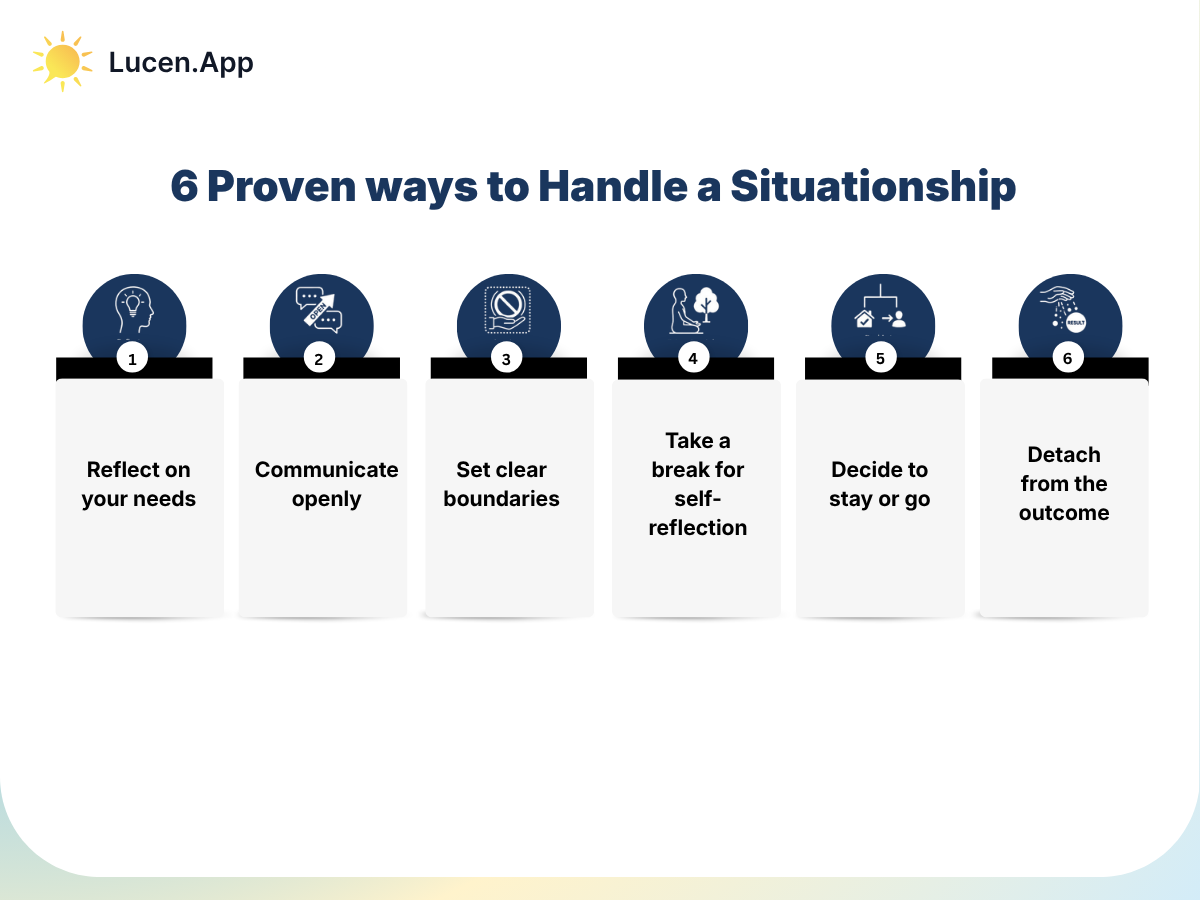
Follow these 6 proven ways to handle a situationship effectively:
- Reflect on your needs: Understand whether you truly want a casual connection, emotional commitment, exclusivity, or long-term stability from the relationship.
- Communicate openly: Discuss your feelings, expectations, and intentions honestly instead of assuming the other person feels the same way.
- Set clear boundaries: Define boundaries around communication, exclusivity, emotional support, and personal expectations to reduce confusion.
- Take a break for self-reflection: Create temporary emotional distance to evaluate how the relationship affects your mental health and well-being.
- Decide to stay or go: Assess whether the situationship aligns with your emotional needs, relationship goals, and long-term happiness.
- Detach from the outcome: Avoid emotionally depending on the hope that the other person will eventually change, commit, or define the relationship if their actions consistently suggest otherwise.
Can a Situationship Turn into a Real Relationship?
Yes, a situationship can turn into a real relationship, but only if both people are emotionally aligned and willing to have an honest conversation about commitment, exclusivity, and long-term intentions. Without a direct conversation about defining the relationship, the connection cannot progress naturally.
Moving from an undefined connection to a committed relationship requires stronger emotional accountability, consistent effort, and a mutual willingness to build trust and intimacy. If both people are not working toward the same relationship goals, the situationship will remain emotionally ambiguous rather than evolve into something stable and defined.
How Long Does the Average Situationship Last?
The average situationship lasts 1-6 months. During this period, many people try to navigate the ambiguity, inconsistent communication, and unclear boundaries that often define situationships. Some situationships may end quickly after a few weeks, while others continue for a year or longer if both individuals remain comfortable with the undefined dynamic.
In many cases, situationships reach a turning point around the 3-month mark, when emotional attachment, questions about exclusivity, or the need for clarity become harder to ignore. Factors such as fear of commitment, convenience, emotional dependence, or the hope that the relationship will eventually become serious can also influence how long a situationship lasts.
How to Know When to Leave a Situationship?
Leave a situationship if there is no progression, one-sided emotional investment, you feel hidden, experience constant anxiety, or have different relationship goals from the other person. These signs often indicate that the relationship is no longer emotionally balanced, emotionally fulfilling, or capable of developing into a healthy, committed partnership.
These are the 5 common scenarios that signal it is time to leave a situationship:
- No progression after several months: If the relationship still lacks exclusivity, commitment, or a clear future direction after months of emotional involvement, the connection may be intentionally left undefined.
- One-sided emotional investment: Constantly initiating conversations, making plans, or shouldering the emotional burden alone often signals an emotional imbalance in the relationship.
- You feel hidden from their life: Avoiding introductions to friends, family, or social circles may reflect a reluctance to acknowledge the relationship publicly or emotionally.
- Persistent anxiety or insecurity: If inconsistent communication and unclear boundaries constantly leave you overthinking or emotionally unsettled, the situationship may be negatively affecting your mental health.
- Different relationship goals: Wanting a committed relationship while the other person prefers a casual connection often leads to long-term frustration and emotional disappointment.
How Can You End a Situationship Healthily?
You can end a situationship in a healthy way by communicating honestly, setting firm boundaries, creating emotional distance, and focusing on self-growth rather than emotional attachment or mixed signals. Ending a situationship clearly and respectfully helps reduce emotional confusion, prevent prolonged emotional dependency, and allow both individuals to move forward with greater emotional clarity.
5 steps to end a situationship in a healthy way are:
- Communicate directly and honestly: Clearly express your feelings, needs, and decisions without blaming or attacking the other person. Honest communication reduces ambiguity and creates emotional clarity for both sides.
- Set firm boundaries: Limit contact, avoid late-night conversations, and stop emotionally confusing interactions that may restart the undefined relationship dynamic.
- Avoid mixed signals: Do not continue flirting, constantly check in emotionally, or maintain relationship-like behavior after ending the situationship.
- Create emotional distance: Take space from communication, social media interactions, and emotionally dependent routines to process the ending in a healthier way.
- Focus on self-growth: Spend time reconnecting with friends, hobbies, career goals, mental health, and personal well-being instead of remaining emotionally attached to the situationship.