To get over a situationship, focus on accepting the reality of the connection, creating your own closure, and prioritizing your emotional well-being. These relationships are particularly challenging to move on from because they involve emotional attachment without clarity, hope for something that may never materialize, mixed signals, and grief over the potential rather than the person. Recognizing the emotional strain and confusion these dynamics create can help you identify when it is time to step away.
Common signs that it may be time to move on include feeling anxious, waiting for clarity, mismatched effort, emotional exhaustion after interactions, and compromising your needs. Once you have acknowledged these signs, take actionable steps to heal, such as cutting or limiting contact, stopping the habit of checking their social media, spending time with supportive friends and family, and prioritizing your mental health through self-care practices. Following these steps helps you regain control, build emotional clarity, and move forward with self-respect and confidence. An AI chat analyzer can help you read the pattern objectively before you decide to walk away.
Why Is It So Hard to Get Over a Situationship?
Getting over a situationship is hard due to emotional attachment, hope for something, a lack of clear closure, mixed signals, and grieving the potential. These connections are built on uncertainty rather than reality, and are difficult to untangle because they exist in a gray area between friendship and commitment.
Here are some factors why it is so hard to get over a situationship:
- You had an emotional attachment without a clear relationship: In a situationship, intimacy often mirrors that of a committed partnership, even without an official label, which makes it hard to get over. Here, you share secrets, spend time together, and invest your vulnerability, triggering bonding hormones like oxytocin. This leads your brain and heart to respond to the consistency of the connection rather than the relationship status. The challenge comes from the disconnect where you feel the full weight of heartbreak, yet a lingering voice tells you it "does not count" because it was not official. To try and overcome this, validate your grief. Remind yourself that the depth of your pain reflects the depth of your feelings, not the presence of a label. Give yourself permission to mourn.
- You kept hoping it would become something real: Many people struggle to let go because a situationship operates entirely on potential. Each sweet message, late-night conversation, or moment of closeness feels like a stepping stone toward a lasting connection, keeping your hope alive. You remain invested, believing that with enough patience or effort, they might eventually commit. One way to work through this is by practicing radical acceptance. Focus on the reality of the arrangement rather than the idealized version you imagined. Recognizing what actually happened, instead of what could have been, helps break the cycle of false hope.
- You did not get a clear closure: Unlike traditional breakups, which often conclude with a final conversation or explanation, situationships rarely offer a definitive endpoint. They frequently fade out, ghost into silence, or cycle through periods of pulling away and returning. This absence of closure leaves your mind trapped in an analytical loop, replaying scenarios and endlessly questioning what went wrong. A helpful approach is to practice self-forgiveness while taking charge of your own closure. Recognize that their silence or avoidance communicates enough, and remind yourself that you do not need their validation to decide the connection no longer serves you.
- The mixed signals kept you emotionally hooked: Hot-and-cold behavior in a situationship keeps you emotionally tethered, making detachment harder. One week, they treat you like a partner, the next like a casual acquaintance, creating a pattern of intermittent reinforcement. Your brain treats each positive interaction as a dopamine spike, while uncertainty fuels anxiety and attachment. To try and overcome this, reframe how you interpret their actions. Stop viewing mixed signals as clues to solve and recognize them as proof of emotional unavailability. True clarity comes from consistent behavior and ambiguity is a signal to detach.
- You are grieving the potential, not just the person: In a situationship, much of the heartbreak comes from mourning what could have been rather than what actually was. You grieve the dates never taken, milestones never reached, and the idealized version of the person you projected onto them. This makes letting go feel heavier and more complicated than a standard breakup. A practical way to cope is to separate the fantasy from reality. Ask yourself whether you miss the person themselves or the future you imagined with them. Recognizing this distinction allows you to grieve the real connection, reclaim clarity, and begin to move forward.
How to Know It Is Time to Let Go of a Situationship?
It is time to let go of a situationship if you feel anxious, are waiting for clarity, avoid defining the relationship, efforts do not match, you feel worse after talking, or you are accepting less than you want. These signs reflect that the connection is no longer supporting your emotional well-being or aligning with your relationship goals, and recognizing them helps you make decisions that prioritize your self-respect and personal growth.
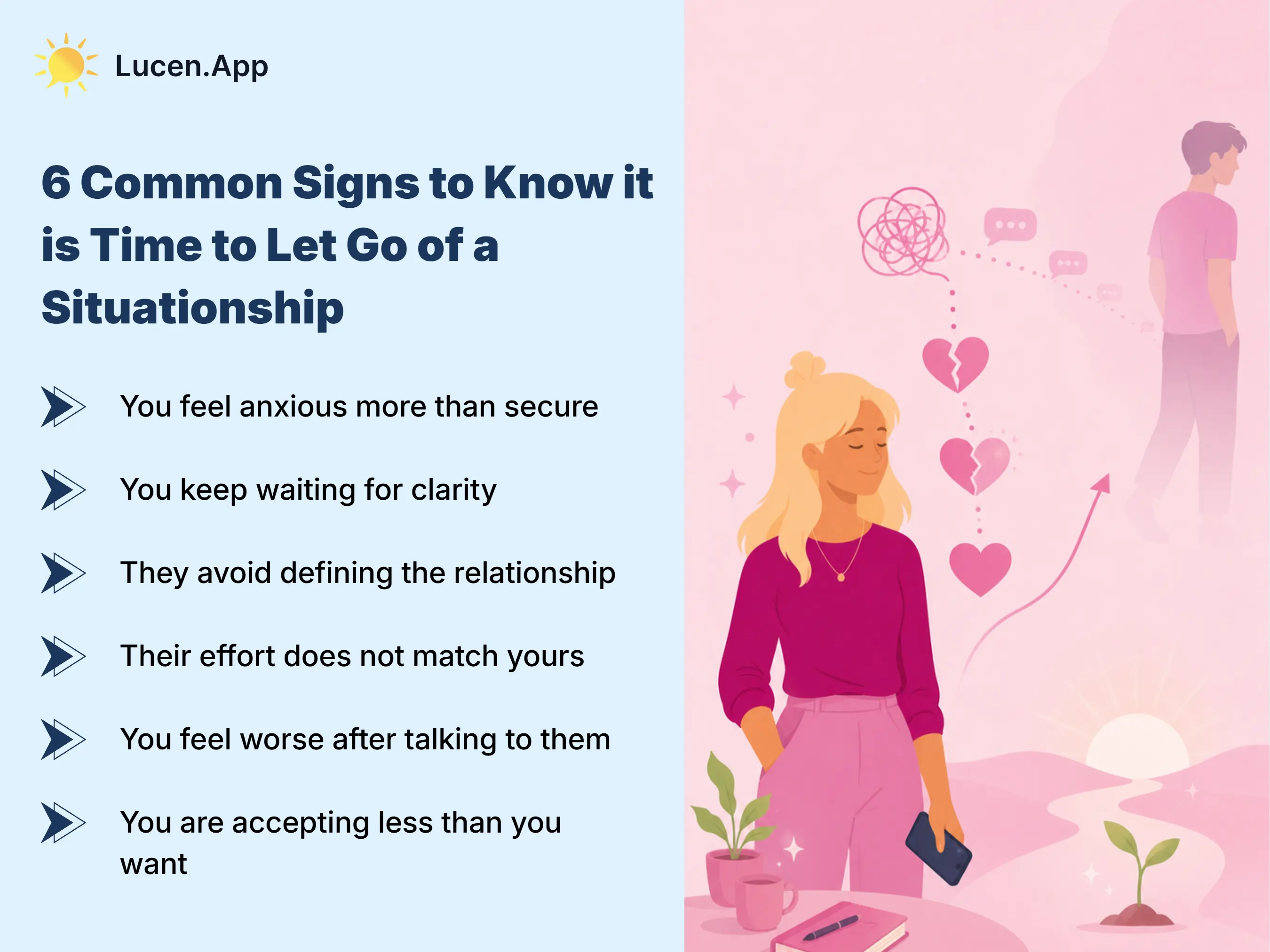
6 common signs to know it is time to let go of a situationship are:
- You feel anxious more than secure: Persistent anxiety, overthinking, or constant worry are strong indicators that a situationship may be harming your emotional health. When you cannot relax or feel at ease around the other person, the connection fails to provide the safety and stability you need. This constant state of hypervigilance can spill over into other areas of your life, affecting work, social relationships, and self-confidence. A helpful approach is to acknowledge these feelings and actively prioritize your mental well-being through mindfulness, setting boundaries, and seeking support from friends, family, or a therapist.
- You keep waiting for clarity: When you find yourself constantly hoping for answers or expecting the situationship to evolve, it can trap you in the emotional limbo of a situationship. Ambiguous connections rarely resolve themselves, and prolonged uncertainty keeps your mind and heart tied to the unknown. Instead, focus on the reality of the relationship. Accept that if clarity is not forthcoming, it is unlikely to appear, and redirect your energy toward your own personal growth and opportunities for healthier connections.
- They avoid defining the relationship: A lack of clear boundaries or commitment often signals that the other person is emotionally unavailable, in which case you must opt out of the situationship. When attempts to discuss the future, your feelings, or mutual expectations are deflected or dismissed, it becomes impossible to build a sense of security or make progress. Recognize avoidance as a reflection of their priorities, and honor your own need for clarity by considering whether stepping away is the healthiest choice.
- Their effort does not match yours: When you consistently invest more time, energy, and emotion than the other person, an imbalance and frustration are inevitable, making it a common sign to opt out of a situationship. This unequal effort can leave you feeling undervalued and drained. Take a moment to evaluate reciprocity. If the connection stalls whenever you stop over-functioning, it is a clear sign to protect your energy and consider moving on.
- You feel worse after talking to them: In a situationship, repeatedly feeling drained, dismissed, or lonely after interactions is a strong signal that the connection is taking a negative toll. Even seemingly positive conversations can leave a bitter aftertaste, revealing a mismatch between emotional investment and fulfillment. Keeping a brief emotional log of your interactions can help you notice patterns and determine when stepping back is necessary for your well-being.
- You are accepting less than you want: A situationship often leads you to compromise your needs to maintain the connection, gradually eroding your self-respect. When unclear boundaries, inconsistent attention, or minimal commitment become the norm, it signals that your emotional requirements are not being met. Reflect on your core standards and priorities, as walking away from a connection that cannot satisfy them is a meaningful act of self-love and protection.
How to End a Situationship Clearly?
To end a situationship clearly, decide what you want before the conversation, communicate your feelings directly, avoid blame, state your boundaries, and create enough space to move on. A clear, direct, and kind ending reduces emotional confusion, prevents mixed signals, and helps both people understand where the connection stands.
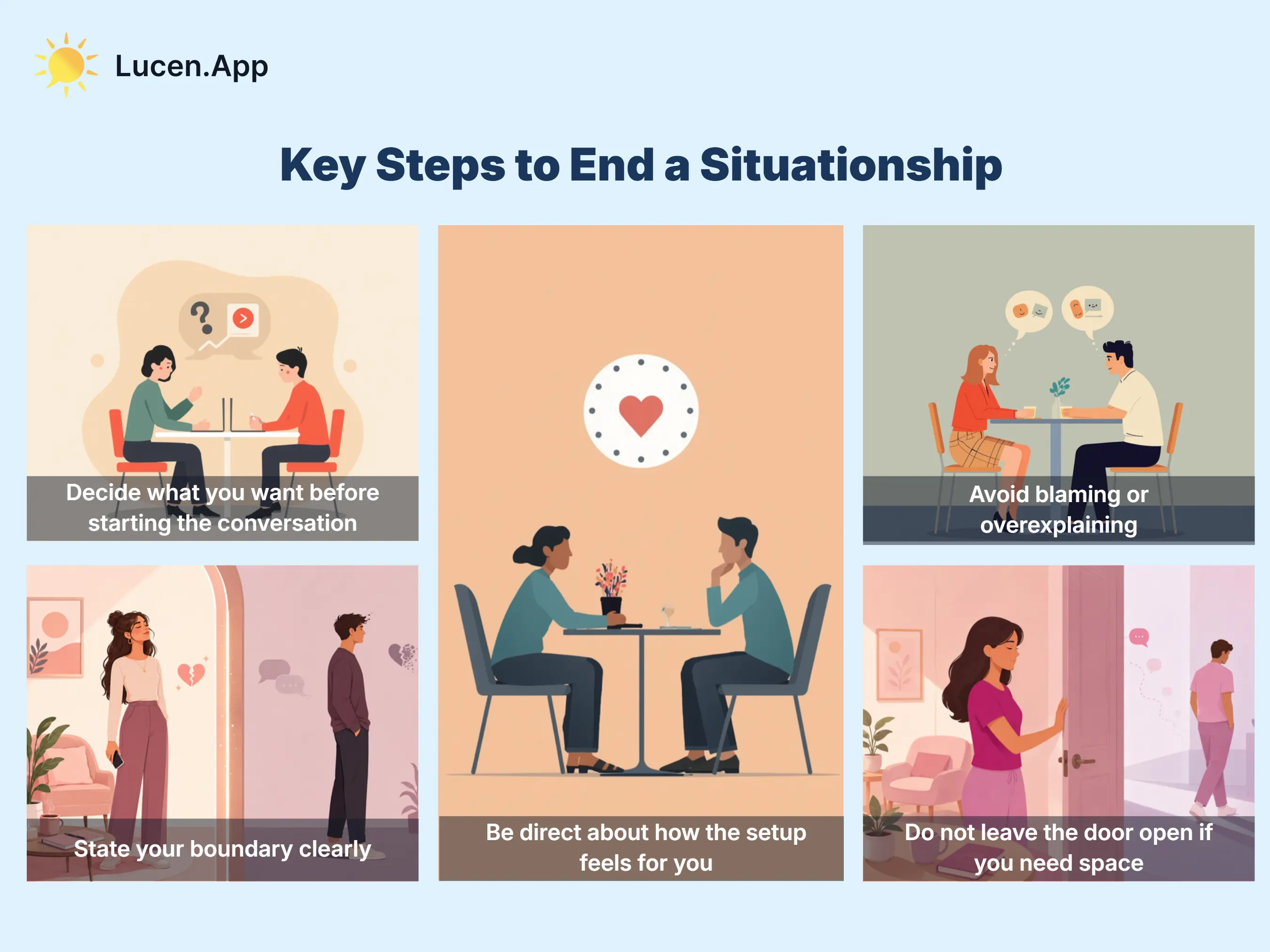
Key steps to end a situationship clearly are:
- Decide what you want before starting the conversation: Before ending a situationship, take time to understand exactly what you want from the conversation. Entering the discussion without a clear goal can lead to mixed messages and prolonged emotional uncertainty. Consider whether you want closure, distance, friendship, or a complete end to the connection. Writing down your thoughts beforehand can help clarify your needs and make it easier to communicate them with confidence. Having a clear outcome in mind creates a stronger foundation for a respectful and direct conversation.
- Be direct about how the setup feels for you: Being honest about your experience helps eliminate ambiguity and allows both people to understand where things stand. Instead of hinting at your feelings or hoping the other person will understand, communicate them clearly and respectfully. Statements such as "I feel uncertain about where this is going, and it is affecting me emotionally" or "This arrangement no longer feels right for me" express your perspective without attacking the other person. Direct communication supports emotional clarity and helps you begin letting go.
- Avoid blaming or overexplaining: Ending a situationship does not require proving that someone was wrong or justifying every detail of your decision. Blame often creates defensiveness, while excessive explanations can invite unnecessary debate or false hope. Focus on your feelings, needs, and decision rather than assigning fault. A simple statement such as "I need something different for myself moving forward" is often more effective than a lengthy explanation. Keeping your message clear and respectful helps preserve your dignity and reduces emotional conflict.
- State your boundary clearly: Clear boundaries are essential when ending a situationship because they remove uncertainty and establish expectations moving forward. Communicate your boundary in direct language that leaves little room for interpretation. For example, you might say, "I am no longer comfortable continuing this arrangement" or "I need to stop seeing each other so I can focus on my well-being." Defining your limits clearly protects your emotional health and creates the space needed to heal.
- Do not leave the door open if you need space: If your goal is to move on, leaving the possibility of future romantic involvement open can make healing much harder. Statements that create ambiguity often keep emotional attachment alive and encourage continued hope. Instead, communicate your need for space directly and consistently. Saying "I need time apart to focus on myself" or "I am stepping back from this connection so I can move forward" establishes a clear path forward. Creating that distance allows you to regain emotional balance and prevents confusion from resurfacing later.
How to Get Over a Situationship Without Closure?
You can get over a situationship without closure by accepting silence as information, letting go of the need for explanations, recognizing relationship patterns, creating your own closure through boundaries, and focusing on unmet needs. Although moving on without answers is difficult, healing becomes easier when you stop looking for closure from the other person and start creating it for yourself.
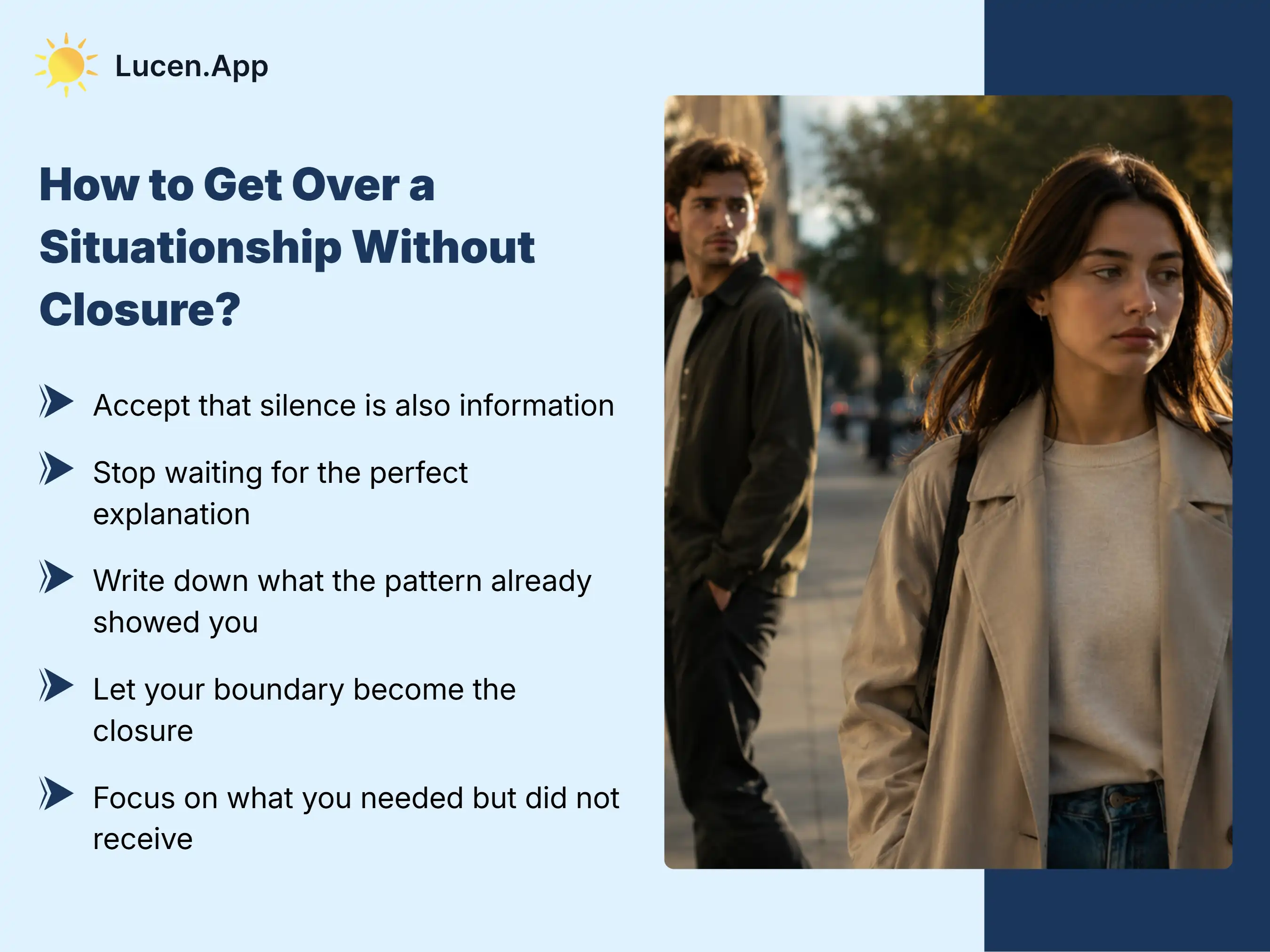
Here is how you can get over a situationship without closure:
- Accept that silence is also information: When a situationship ends without closure, silence can become part of the answer. If someone stops responding, avoids honest conversations, or disappears without explanation, their actions reveal their level of interest, emotional availability, and willingness to invest. Instead of waiting for a conversation that may never happen, treat their withdrawal as information that helps you understand the reality of the connection and begin letting go.
- Stop waiting for the perfect explanation: One major obstacle to getting over a situationship without closure is waiting for a final explanation. You may hope an apology or conversation will make everything make sense, but even clear answers may not change the outcome. Rather than putting your healing on hold, accept what already happened and redirect your energy toward recovery.
- Write down what the pattern already showed you: Getting over a situationship without closure often means finding clarity without the final conversation you wanted. Instead of focusing on a few meaningful moments, look at the overall pattern of the relationship. Write down recurring behaviors such as inconsistent communication, canceled plans, emotional unavailability, or avoidance of commitment. Seeing these patterns on paper helps replace unanswered questions with objective reality, making it easier to accept what the situationship truly was and move forward without the closure you never received.
- Let your boundary become the closure: One way to get over a situationship without closure is to stop waiting for the other person to provide it. If they cannot offer an explanation, an apology, or an acknowledgment, your boundary can become the end. Limiting contact, unfollowing them on social media, or refusing to re-enter the same cycle creates a clear line between the past and present. By maintaining that boundary, you create your own closure and give yourself the space needed to heal.
- Focus on what you needed but did not receive: Getting over a situationship without closure becomes easier when you stop focusing on why it ended and start focusing on what was missing throughout the relationship. While the connection may have provided companionship or attraction, it may not have provided consistency, commitment, emotional safety, or clear communication. Recognizing these unmet needs helps validate your decision to move on and reminds you that the real issue was not the lack of closure but that your core relationship needs were never fully met.
How to Move On From a Situationship?
To move on from a situationship, cut or limit contact, stop checking their social media, spend time with friends and family, allow yourself to grieve, meet new people, and prioritize your mental health. Focusing on healthy boundaries, support systems, and personal growth can help you gradually detach from the connection and move forward with greater confidence.
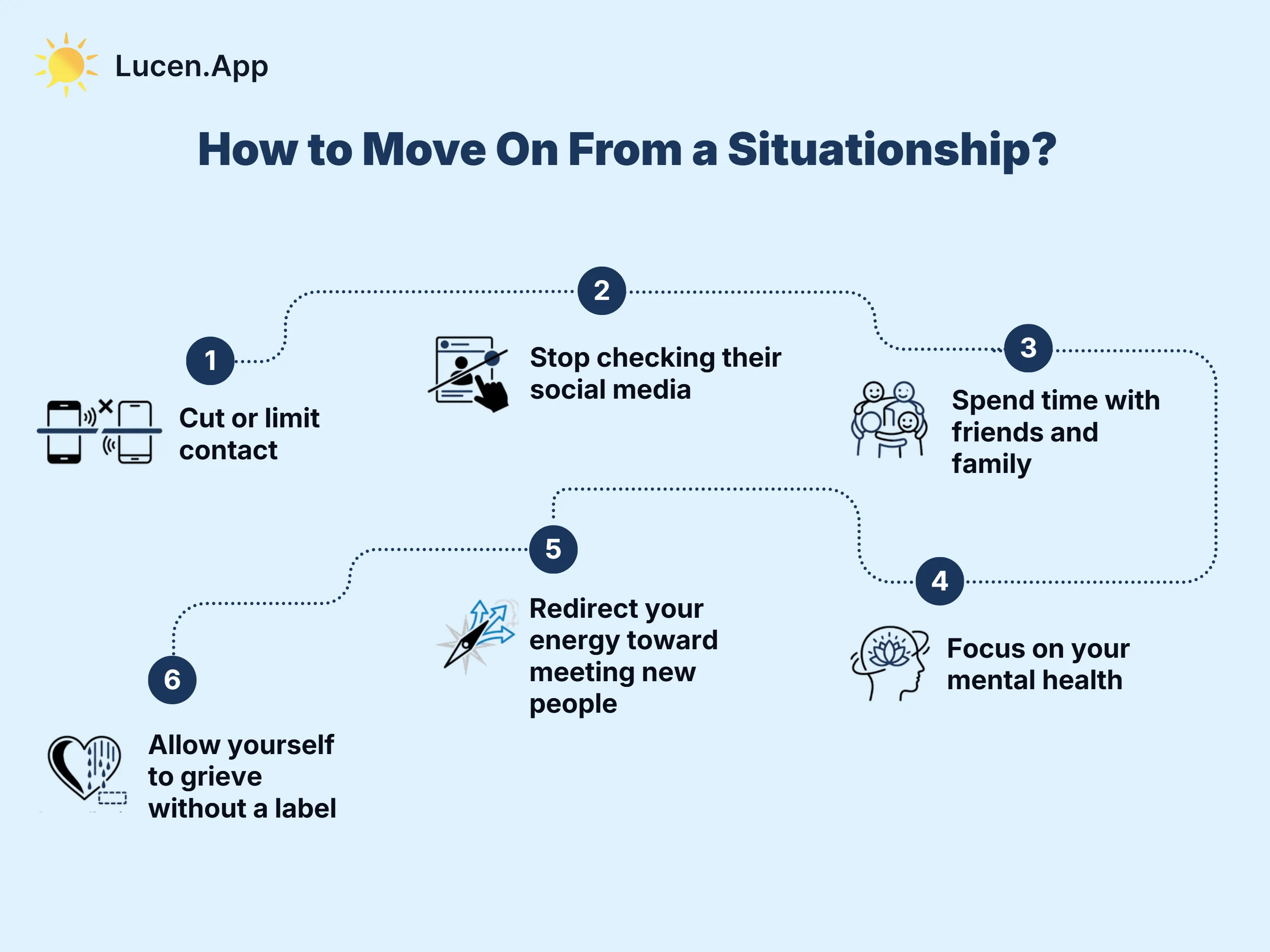
Follow the methods below to move on from a situationship:
- Cut or limit contact: Limiting contact is one of the most effective ways to move on from a situationship because it reduces the emotional triggers that keep you attached. Continued texting, calling, or meeting up can reopen wounds and create false hope that the situation might change. Creating distance gives you the mental space needed to process your feelings and regain emotional clarity. This may involve reducing communication, avoiding unnecessary interactions, or setting boundaries around when and how you engage with them.
- Stop checking their social media: Checking an ex-situationship partner's social media is a toxic habit that actively prolongs your attachment and fuels painful overthinking. Looking at their stories or status updates provides an artificial hit of connection that keeps you hooked on false hope while chipping away at your self-respect. To apply this, block or mute their accounts immediately. Removing the visual temptation breaks the mental preoccupation and allows you to regain cognitive clarity.
- Spend time with friends and family: Leaning heavily on a trusted social support network provides a vital anchor that counters the isolation of an unlabeled breakup. Sharing meals, conversations, or simple outings with loved ones reminds you of what a secure, unconditional connection actually feels like. For this, schedule consistent weekly plans with friends and family members as their presence actively rebuilds your compromised self-worth and grounds you in a healthier, safer reality.
- Allow yourself to grieve without a label: Validating your internal pain without forcing it into a traditional category is essential for complete psychological healing. You do not need to have been an official boyfriend or girlfriend to mourn the genuine depth of the emotional investment and intimacy you shared. To apply this, accept your tears, sadness, and anger without self-judgment, remembering that your grief reflects the reality of your feelings, not a status.
- Redirect your energy toward meeting new people: Redirecting your energy toward meeting new people helps break the emotional patterns tied to the situationship. Expanding your social circle introduces new experiences, perspectives, and opportunities for connection. This does not mean rushing into another relationship before you are ready. Instead, it means investing your time in activities, communities, and social opportunities that help you reconnect with life beyond the situationship. Over time, new connections can help shift your focus away from the past and toward future possibilities.
- Focus on your mental health: Prioritizing your mental health strengthens your ability to recover and move on from a situationship. Situationships can create emotional stress, self-doubt, and anxiety, making self-care especially important during the healing process. Activities such as therapy, journaling, mindfulness, exercise, and maintaining healthy daily routines can support emotional resilience and personal growth. Focusing on your mental well-being not only helps you recover from the situationship but also prepares you for healthier relationships in the future.
How Long Does It Take to Get Over a Situationship?
Getting over a situationship can take anywhere from 1 to 3 months or even more, depending on factors such as your level of emotional attachment, the length of the situationship, the amount of ongoing contact, and the support system available to you. Because situationships often lack clear boundaries and closure, recovery can sometimes feel more complicated than moving on from a committed relationship.
Rather than focusing on a specific timeline, focus on your healing progress. Creating boundaries, processing your emotions, leaning on friends and family, and prioritizing your mental health can help you gradually move forward at a pace that feels right for you.
Can You Be Friends After a Situationship?
Yes, you can be friends after a situationship, but it is not easy. The emotional complexity of a situationship often leaves lingering feelings, unresolved expectations, or attachment that can make a platonic friendship difficult to maintain. Because the connection lacked clear boundaries or a defined relationship status, both people may struggle to separate the past romantic or sexual dynamic from a healthy friendship.
If both individuals have genuinely moved on, communicate openly, and establish clear boundaries, a friendship may be possible. However, taking time apart first is often necessary to ensure the friendship supports emotional well-being rather than prolonging confusion or attachment.
Should You Try to Get Closure or Just Move On?
In a situationship, it is usually healthier to move on without seeking closure, though there may be moments, such as when you are tempted to ask about why things ended or seek reassurance, where a conversation feels appealing. While closure can sometimes provide answers, situationships often end ambiguously, and the other person may not be willing or able to give the explanation you hope for.
Chasing closure can prolong emotional attachment and slow the healing process. Instead, focus on accepting what happened, learning from the experience, and creating your own closure through boundaries and self-reflection. Ultimately, moving on from a situationship allows you to regain control and emotional clarity without relying on someone else.
How to Read the Pattern Instead of Waiting for Closure?
To read the pattern instead of waiting for closure, observe communication habits, track follow-through, evaluate responsiveness, and recognize recurring emotional patterns. Paying attention to these consistent behaviors provides insight into the true nature of the situationship without needing a final explanation.
Follow the steps below to read the pattern instead of waiting for closure:
- Observe communication habits: Notice how consistently they respond to messages and engage in conversations.
- Track follow-through: Pay attention to whether they honor plans or frequently cancel or reschedule.
- Evaluate responsiveness to your needs: See if they acknowledge your feelings, boundaries, and emotional requests.
- Identify avoidance behaviors: Look for signs of deflection, unwillingness to define the relationship, or reluctance to commit.
- Recognize recurring emotional patterns: Take note of repeated highs and lows that create attachment or confusion.
- Make decisions based on patterns, not words: Let the behaviors guide your choice to move on rather than waiting for closure from them.