Situationships involve romantic or sexual connections with emotional ambiguity, unclear boundaries, and undefined labels, while FWB is centered on physical intimacy, clear rules, and minimal emotional expectations. In a situationship, partners may act like a couple but avoid defining the relationship, often experiencing inconsistent communication, fluctuating plans, and emotional uncertainty. FWB relationships, by contrast, maintain friendship while prioritizing sexual activity, mutual agreement on no commitment, and explicitly defined boundaries. Recognizing these differences helps individuals identify their relationship type and set realistic expectations.
Key signs of a situationship include acting like a couple without a label, emotional attachment without clarity, inconsistent plans, avoidance of defining the connection, and seeking clarity that is not provided. For FWB, signs include sexual intimacy as the focus, mutual understanding of non-commitment, limited emotional expectations, clear boundaries, and a casual yet respectful dynamic. Reassessing either arrangement is recommended when boundaries, expectations, or emotional needs are misaligned, though both relationship types can evolve into a committed relationship if communication, emotional investment, and clarity align. An AI chat analyzer can read these patterns in your messages and help you tell which one you're in.
What Is a Situationship?
A situationship is a romantic or sexual connection that lacks clear boundaries, labels, or formal commitment. Unlike traditional relationships, it occupies a gray area where emotional involvement exists but remains undefined. Partners in a situationship may spend time together, share intimacy, or act like a couple, yet deliberately avoid explicitly labeling the relationship.
People often enter situationships for flexibility, convenience, or as a transitional phase in life, allowing them to enjoy companionship without the pressures of commitment. These relationships typically feature inconsistent communication, fluctuating plans, and unclear expectations, which can create confusion about the connection and each person's intentions.
What Is a Friends With Benefits Relationship?
A friends-with-benefits (FWB) relationship is a friendship that includes sexual activity without the commitment, romantic expectations, or labels of a traditional relationship. In this type of relationship, two friends agree to maintain their friendship while engaging in physical intimacy, deliberately avoiding a conventional romantic partnership.
Key attributes of an FWB relationship include a mutual understanding that neither person is seeking commitment, clearly defined rules or boundaries, such as agreements on exclusivity or sexual health, and efforts to minimize emotional attachment. Variations of FWB include monogamous FWBs who agree to be exclusive in their physical connection, or long-distance FWBs who maintain the arrangement across geographical separation.
How Do Situationships and Friends With Benefits Compare?
Situationships involve emotional ambiguity and unclear expectations, whereas friends-with-benefits (FWB) relationships emphasize clarity, clearly defined boundaries, and minimal emotional attachment. While FWBs operate through mutual agreements and structured rules, situationships often feature inconsistent communication, fluctuating plans, and uncertainty about each partner's intentions. Recognizing these differences helps individuals understand their relationship dynamic and set realistic expectations for their connection.
The table below outlines how situationship and FWB compare across their core structural axes:
| Feature | Situationship | Friends With Benefits (FWB) |
|---|---|---|
| Primary Intent | Mimics a romantic connection but lacks formal commitment or long-term planning | Prioritizes a physical connection built on an existing platonic friendship |
| Commitment | No explicit commitment | No commitment, just mutual agreement |
| Communication | Often vague, sporadic, or avoidant | Direct, straightforward, and upfront |
| Boundaries | Flexible or vague | Clearly defined |
| Expectations | Often unclear | Clearly established and mutually understood |
| Potential for Relationship | May evolve into a committed relationship if clarity emerges | Possible but less common |
What Signs Help You Tell Which One You're In?
Signs of a situationship include unclear labels, emotional uncertainty, inconsistent plans, and reluctance to define the relationship, whereas FWB signs include a focus on physical intimacy, mutual agreement, limited emotional expectations, and clear boundaries. Observing these patterns helps you identify your relationship type and manage expectations.
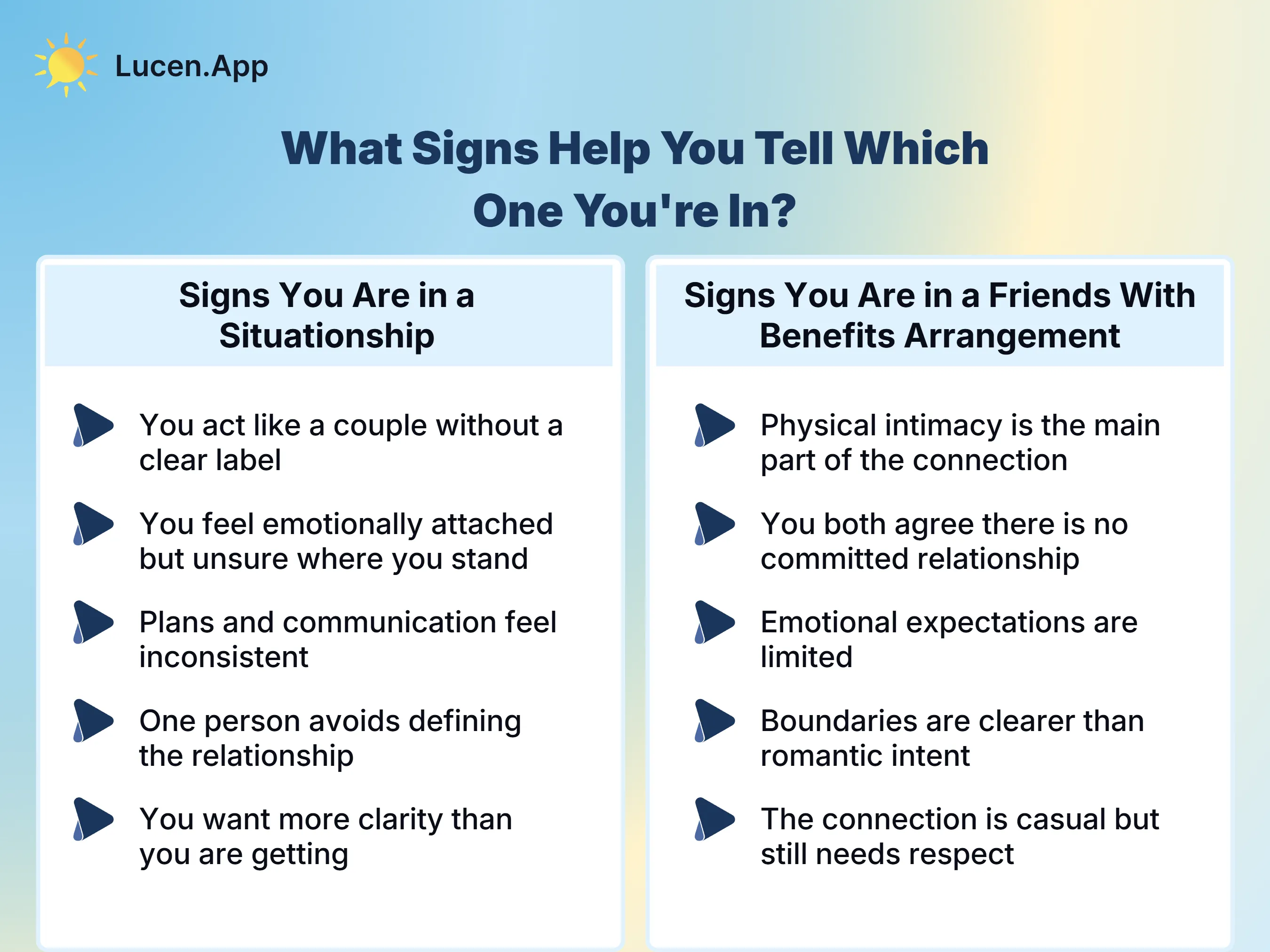
Signs You Are in a Situationship
- You act like a couple without a clear label: Spending significant time together, sharing personal stories, or participating in couple-like activities, yet avoiding a defined status (e.g., girlfriend, boyfriend) and conversations about "what are we" is a major sign of a situationship. Such ambiguity can create confusion for both partners and blur boundaries between friendship and romance.
- You feel emotionally attached but unsure where you stand: Feeling anxious, thinking about the other person often, or caring deeply without knowing their feelings is a clear sign of a situationship. In a situationship, emotional investment exists, but the lack of defined boundaries leaves you unsettled.
- Plans and communication feel inconsistent: Fluctuating dates, messages, or check-ins reflect a lack of structure and predictability, which is a key sign of a situationship. Such inconsistency can make it difficult to rely on the relationship for emotional support and often leaves one or both partners feeling uncertain about where they stand.
- One person avoids defining the relationship: When a partner resists labeling the connection, it leaves roles and future intentions ambiguous. This avoidance is characteristic of a situationship and can create tension and unspoken questions.
- You want more clarity than you are getting: Seeking conversations about commitment or the future, only to face avoidance, highlights the undefined nature of a situationship. The unmet need for clarity often leads to frustration, doubt, and emotional stress.
Signs You Are in a Friends With Benefits Arrangement
- Physical intimacy is the main part of the connection: In an FWB relationship, sexual activity takes priority while emotional bonding or romantic involvement is intentionally limited. The focus on the physical nature of the connection is a key sign of this type of arrangement.
- You both agree there is no committed relationship: Both partners clearly understand that neither is seeking exclusivity or long-term commitment. This mutual agreement is a key sign of an FWB arrangement and helps prevent misunderstandings or unmet expectations.
- Emotional expectations are limited: While friendship may remain important, emotional attachment is intentionally minimized. Keeping emotional involvement low is a defining characteristic of FWB relationships and helps maintain the connection's casual nature.
- Boundaries are clearer than romantic intent: Explicit rules, such as sexual health agreements, meeting frequency, or exclusivity, are established to protect both parties. Clear boundaries without romantic expectations indicate an FWB arrangement.
- The connection is casual but still needs respect: Even in its informal nature, both partners are expected to communicate honestly, honor agreements, and treat each other with courtesy. Respectful behavior helps maintain a positive FWB dynamic and prevents emotional harm.
When Should You Reassess a Situationship or Friends With Benefits?
You should reassess a situationship if you face emotional confusion, unmet expectations, or inconsistent communication, whereas you should reassess an FWB if boundaries are crossed, rules are ignored, or commitment needs change. Recognizing these signals helps you decide whether to clarify, renegotiate, or end the relationship.
Reassess a situationship if:
- The emotional ambiguity is causing you constant anxiety.
- You are settling for less than what you actually want.
- Communication has become entirely unpredictable.
- One person is actively avoiding the Define the Relationship conversation.
Reassess a FWB if:
- One or both of you start catching romantic feelings.
- Basic respect and clear communication begin to drop off.
- The lines of friendship are starting to blur into pseudo-romance.
- The connection is holding you back from real dating.
Can a Situationship Turn Into a Relationship?
Yes, a situationship can turn into a relationship if both partners develop mutual emotional investment, clarify intentions, and communicate openly about exclusivity and future goals. The potential for this transition depends on several factors, including consistent behavior that demonstrates reliability and care, a willingness from both parties to define the relationship, and alignment of long-term desires and values.
Recognizing and addressing emotional ambiguity, actively discussing expectations, and showing consistent effort in actions and communication can signal readiness for commitment. Additionally, both partners must be emotionally available and willing to navigate uncertainties, as the shift from a loosely defined connection to a formal relationship requires trust, transparency, and shared goals for the future.
Can FWB Turn Into a Relationship?
Yes, a friends-with-benefits (FWB) arrangement can turn into a committed relationship, but the transition is not automatic and depends on several emotional and communication factors. For this shift to occur, both individuals need to develop a deeper emotional attachment and openly discuss their feelings and intentions.
Mutual willingness to redefine the relationship and establish clear boundaries plays a crucial role in the process. Unlike a situationship, which often remains vague and undefined, a successful transition from FWB to a committed relationship requires explicit communication about exclusivity and future expectations.
How to Read Mixed Signals in a Situationship or FWB?
To read mixed signals in a situationship or FWB, watch the consistency, evaluate breadcrumbs, assess the effort, initiate direct communication, and protect your peace. By combining these steps with careful observation and open communication, you can better understand the intentions behind mixed signals and make informed decisions about your relationship.
Here is how you can read the mixed signals in a situationship or FWB:
- Observe Consistency: Notice how often they reach out or make plans. If they contact you only at convenient times or late at night, it may indicate that they prioritize physical connection over emotional involvement.
- Evaluate the Breadcrumbs: Actions speak louder than words, so point out if they claim to care but rarely make time for you or support you in meaningful ways — their words may simply be keeping you around.
- Measure the Effort: Pay attention to whether they remember small details about you or include you in parts of their life beyond the physical aspect, like social gatherings or shared activities.
- Have Direct Conversations: The clearest way to end confusion is to ask where you both stand. Use "I" statements to express your needs, for example: "I enjoy spending time with you and want to ensure we are on the same page about this connection."
- Protect Your Well-being: If their behavior leaves you feeling anxious, insecure, or constantly second-guessing, the arrangement may no longer serve your emotional needs. It's okay to step away if your expectations and boundaries aren't respected.