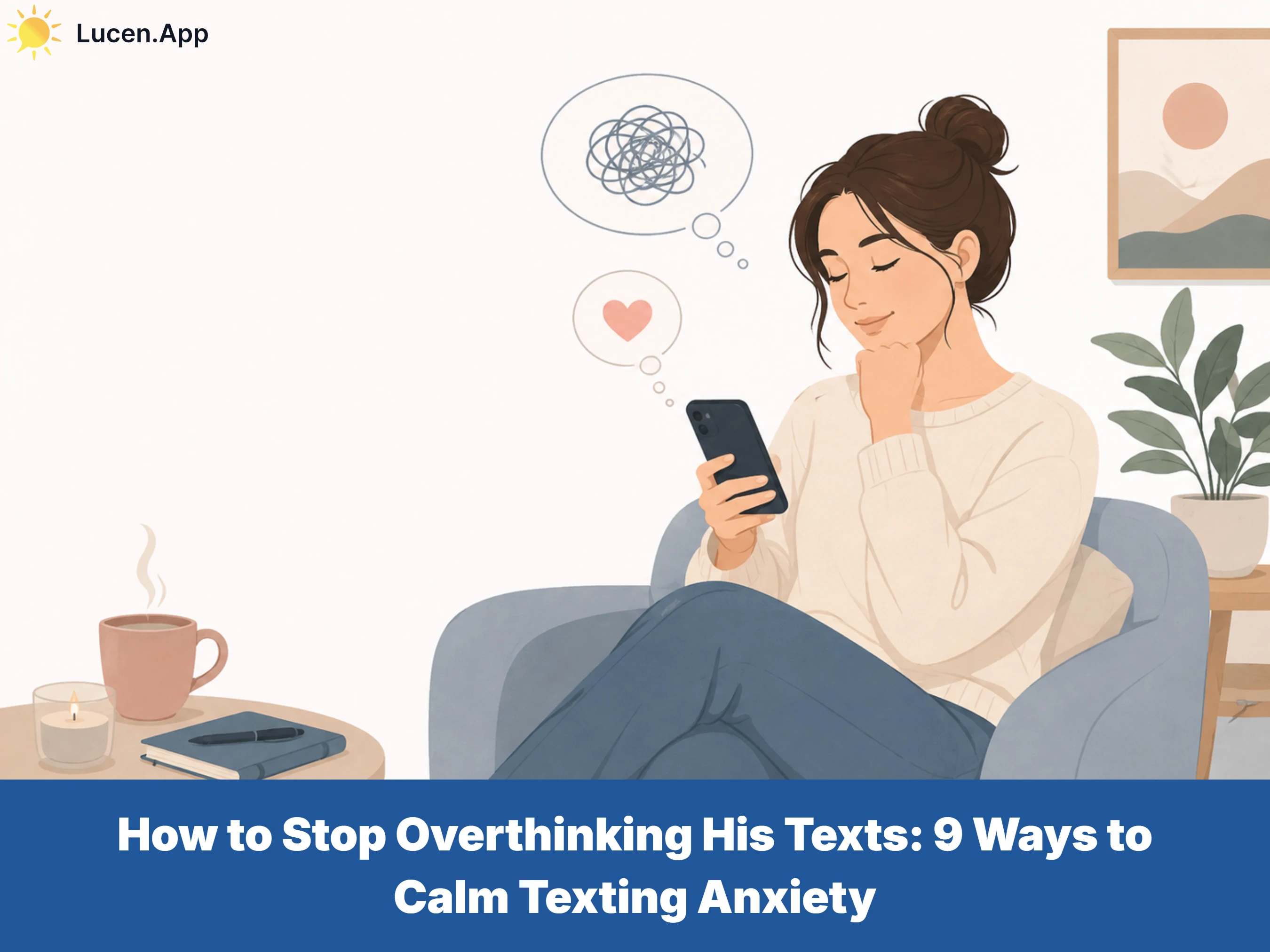
To stop overthinking his texts, read each message for its plain meaning, separate what you know from what you fear, put your phone away until the emotional reaction settles, and wait until you feel calm before replying. Avoid asking friends to analyze every word, rewriting your response to make it perfect, or treating reply time as proof of rejection, and focus on your own routine instead of monitoring your phone. Judge the connection through consistent communication and behavior over time rather than individual messages.
Texting anxiety often grows when uncertainty is mistaken for evidence, making ordinary message details seem more meaningful than they really are. Looking at the literal message, responding calmly, and evaluating repeated communication patterns instead of isolated texts creates a more balanced perspective. Healthy texting habits encourage clearer communication, reduce impulsive reactions, and keep expectations grounded in observable behavior rather than assumptions about another person's intentions or feelings.
9 ways to calm texting anxiety are:
Read the Message for Its Plain Meaning Before Adding Assumptions
Focus on the exact words before interpreting their meaning, as anxiety can turn missing information into assumptions that the message does not support. Notice the exact words, stated information, and direct request. A short reply, missing emoji, or different tone may feel important, but those details do not automatically confirm rejection, anger, or reduced interest.
Separate the visible message from the meaning anxiety adds by asking two questions: "What did he actually say?" and "What am I assuming?" Prior expectations and uncertainty can distort interpretation, making neutral messages feel more loaded than they are. Focus on the literal communication first, wait for more context before deciding what the text means, and let consistent patterns over time guide your understanding rather than a single message.
Separate What You Know from What You Fear
Distinguish what you know from what you fear, so uncertainty does not automatically become proof of rejection or changing interest. A delayed reply may trigger thoughts that his interest has changed, but the only confirmed fact may be that he has not responded yet. Anxiety often turns missing information into a negative story.
Create two clear categories: what you know and what you fear. Place observable details under facts and imagined outcomes under fears. Leave uncertain information unclassified until communication provides evidence. This process slows overthinking, reduces impulsive texting, and helps you respond to the situation instead of treating an anxious prediction as proof of rejection or behavior.
Put Your Phone Away Until the Emotional Reaction Settles
Set your phone aside after a triggering message, allowing your emotional reaction to settle before you reread, check, or respond. Keeping it nearby can encourage rereading, drafting, and monitoring notifications. Each action can restart overthinking and make the message feel more urgent or meaningful than the available information supports.
Create physical distance by silencing notifications, leaving the phone in another room, or starting a focused task. Allow your body and thoughts to settle before seeking more information or taking action. When the intensity decreases, review the text again, identify the facts, and decide whether a reply is needed. Physical distance interrupts overthinking and supports much calmer behavior.
Wait Until You Feel Calm Before Sending a Reply
Pause before replying when emotions run high so your message reflects what you genuinely think rather than an immediate reaction driven by anxiety. An emotionally charged text can create an urge to explain, confront, defend yourself, or seek reassurance immediately. A fast response may reflect uncertainty more than the message you genuinely want to communicate.
Pause until your breathing, thoughts, and attention feel steady. Then decide what you want the reply to accomplish, such as answering a question, expressing a concern, or requesting clarity. Use clear language that reflects your intention. Delaying the response does not mean avoiding communication. It gives you time to reduce overthinking and prevent avoidable communication conflict.
Stop Asking Friends to Analyze Every Word or Punctuation Mark
Stop asking friends to decode every word, emoji, or punctuation mark because multiple interpretations often create more uncertainty instead of giving a reliable answer about the text. Sending screenshots to several people may produce different explanations. Those opinions can increase anxiety because no one can confirm another person's private intention from one message alone.
Ask friends for emotional support rather than message decoding. Say the text made you anxious and ask them to help separate facts from assumptions. Avoid reassurance about what he "must" mean. Direct communication and repeated behavior provide stronger evidence than theories about punctuation or response style. Limiting outside analysis reduces overthinking and ambiguity.
Avoid Rewriting Your Response to Make It Perfect
Send a clear and genuine reply instead of chasing the perfect message because repeated rewriting usually increases self-doubt without making communication more accurate. Every edit can make ordinary texting feel like a test where every word must prevent misunderstanding. Searching for certainty often keeps anxiety active instead of improving the conversation.
Write what you genuinely mean, check it once for clarity and tone, then stop revising. Focus on whether the reply answers the message and represents your intention. Small imperfections do not automatically damage communication or interest. Accepting uncertainty prevents anxiety from controlling your wording. A straightforward response supports healthier texting than a polished message shaped by overthinking.
Do Not Treat Reply Time as Proof of Rejection or Interest
Treat reply time as one detail rather than proof of interest, as texting speed can change for reasons unrelated to attraction or commitment. A fast response may feel reassuring, while a delayed reply may increase anxiety, yet timing alone cannot confirm attraction, commitment, rejection, or emotional availability.
Consider the wider communication pattern instead of assigning fixed meaning to one delay. Text response time etiquette makes more sense when you notice whether he follows through, initiates contact, answers important questions, and behaves respectfully over time. Context gives reply time more meaning than the clock alone. This approach reduces overthinking and helps you evaluate interest through repeated communication and behavior instead of uncertainty.
Focus on Your Routine Instead of Monitoring Your Phone
Shift your attention back to work, hobbies, and daily responsibilities rather than waiting for every notification to ease texting anxiety. Repeatedly checking notifications, read receipts, or online status can make one unanswered text dominate your thoughts and distract you from everyday responsibilities.
Continue with work, hobbies, exercise, responsibilities, or plans with friends. Choose activities that require attention and give your mind another focus. Maintaining your routine does not mean ignoring communication or pretending you lack interest. It protects balance while you wait. Reducing phone monitoring calms texting anxiety and keeps one reply in perspective within your life.
Judge the Connection by Consistent Communication and Behavior
Evaluate the relationship through repeated effort, communication, and behavior because an isolated text cannot reliably explain someone's level of interest. One warm reply may create hope, while one short or delayed message may create doubt. Neither isolated moment offers enough information to support a reliable conclusion.
Watch what happens across several interactions. Notice whether both people initiate, follow through, communicate respectfully, and make an effort. Compare his words with his actions and consider whether the overall pattern feels steady or inconsistent. Repeated behavior provides stronger evidence than one message, emoji, or pause. Focusing on patterns reduces overthinking and supports fair judgment.
Why Do You Overthink His Text Messages?
You overthink his text messages because uncertainty, emotional investment, fear of rejection, past relationship experiences, and limited contextual cues in digital communication can work together to create doubt. Texting provides only words, leaving many emotional details unseen. When the situation feels personally important, the mind may connect missing information with previous experiences or worries. That combination can make ordinary messages seem far more meaningful than the available evidence actually supports.
Reasons you overthink his text messages include:
Texts Remove Tone, Facial Expressions, and Body Language
Text messages remove tone, facial expressions, eye contact, gestures, and vocal inflection, leaving words without the emotional context normally used to interpret meaning. A short reply may reflect distraction, tiredness, or limited time, yet the absence of nonverbal cues makes multiple interpretations seem equally possible, encouraging repeated analysis instead of immediate understanding and increasing unnecessary uncertainty.
Uncertainty Makes Your Mind Fill Gaps with Negative Stories
When information is incomplete, the brain naturally tries to create a coherent explanation for missing details. During emotionally important conversations, this process often favors caution by imagining disappointing outcomes before positive ones. As uncertainty grows, ordinary pauses, short replies, or vague wording become starting points for increasingly negative interpretations without supporting evidence.
Fear of Rejection Makes Small Message Details Feel Important
Concern about rejection increases attention toward small details because emotionally significant situations heighten sensitivity to possible signs of disappointment. A short reply, delayed response, or simple punctuation mark can appear unusually meaningful when rejection already feels possible. Overthinking develops because ordinary communication becomes filtered through fear instead of remaining connected to observable information.
Past Dating Experiences Shape How You Interpret New Messages
Previous relationship experiences can influence why you overthink his text messages by shaping how new conversations are interpreted. Earlier disappointments, inconsistent communication, or painful endings can increase emotional sensitivity during texting. New messages may seem connected to old experiences, causing past expectations to influence present interpretations before enough current evidence becomes available.
Emotional Attachment Increases the Need for Reassurance
Greater emotional investment can make overthinking his texts more likely because reassurance becomes increasingly important as the connection feels more meaningful. Messages carry greater emotional weight when the relationship matters, making uncertainty harder to tolerate. Overthinking develops as the mind searches for signs of security within ordinary communication, even though individual texts rarely provide complete emotional certainty.
Anxious Attachment Can Make Delayed Replies Feel Threatening
Waiting for his reply can trigger overthinking when attachment-related insecurity makes periods of silence feel emotionally significant. Delayed responses leave uncertainty unresolved, allowing fears about connection or acceptance to become more noticeable. Emotional reactions can become stronger than the limited evidence available, making silence feel more meaningful than the communication itself supports.
Low Confidence Can Make His Response Feel Tied to Your Worth
Low self-confidence can cause you to overthink his texts by connecting another person's response with your own sense of worth. A brief message or delayed reply may feel like evidence about personal value instead of reflecting one moment within an ongoing conversation. Overthinking grows when self-esteem becomes closely linked to another person's texting behavior.
Insecure Texting Habits Reinforce Checking and Reassurance-Seeking
Repeated checking and reassurance-seeking can strengthen overthinking because each attempt to reduce uncertainty keeps attention fixed on the conversation. Monitoring notifications, rereading messages, or searching for hidden meanings increases emotional investment without adding reliable information. The cycle continues as temporary reassurance fades, encouraging more checking instead of creating lasting confidence about the communication.
How Does Texting Anxiety Distort the Meaning of His Messages?
Texting anxiety distorts the meaning of his messages by making short replies, delayed responses, punctuation, changes in texting frequency, neutral wording, and vague messages seem more emotionally significant than the available evidence supports. Limited contextual cues leave room for uncertainty, allowing personal fears and expectations to shape interpretation. Ordinary communication details can then feel like proof of rejection, distance, or changing interest without actually confirming those conclusions.
Several texting patterns that can trigger texting anxiety are:
Short Replies Can Appear Cold or Dismissive
Brief responses often lead to overthinking his text messages, as fewer words leave more room for personal interpretation than emotional clarity. Dry texting may feel distant when warmth or reassurance is expected, even though message length alone cannot explain another person's mood, interest, or intention. Missing context encourages assumptions that extend beyond the actual communication.
Delayed Replies Can Feel Like Rejection
Late replies often trigger overthinking his messages by creating unanswered questions before any new communication becomes available. Waiting without additional context allows uncertainty to grow, making silence feel emotionally significant. The passage of time can become linked with imagined outcomes, even though a delayed response alone cannot confirm rejection, reduced interest, or changing feelings.
Punctuation Can Seem Emotionally Loaded
Small punctuation marks can encourage overanalyzing his texts when they become substitutes for tone, facial expressions, and vocal cues. A period, question mark, or emoji may seem to signal frustration, distance, or enthusiasm when supporting context is unavailable. Texting anxiety encourages emotional meaning to be assigned beyond what punctuation alone can reliably communicate.
Changes in Texting Frequency Can Seem Like Lost Interest
Shifts in texting frequency can make you overthink his messages as noticeable changes naturally raise questions about the relationship before enough context exists. Receiving fewer texts may feel emotionally significant once communication patterns become familiar. Reduced frequency can invite concern, although texting patterns alone cannot establish another person's interest, commitment, or emotional availability.
Neutral Wording Can Feel Negative During an Anxious State
Ordinary wording can seem emotionally negative when texting anxiety shapes how neutral language is interpreted. Simple phrases without obvious warmth or enthusiasm may appear distant when reassurance feels important. Emotional concerns influence how familiar words are understood, allowing assumptions to shape interpretation beyond the information contained within the message itself.
Vague Messages Can Invite Imagined Meanings
Unclear messages often increase overthinking because unclear wording leaves enough uncertainty for imagined meanings to replace confirmed information. Limited detail creates space for several possible explanations, making uncertainty feel harder to tolerate when the connection matters. The mind begins filling those gaps with personal interpretations, even though the message itself does not confirm any single conclusion.
What Should You Do When He Does Not Text Back?
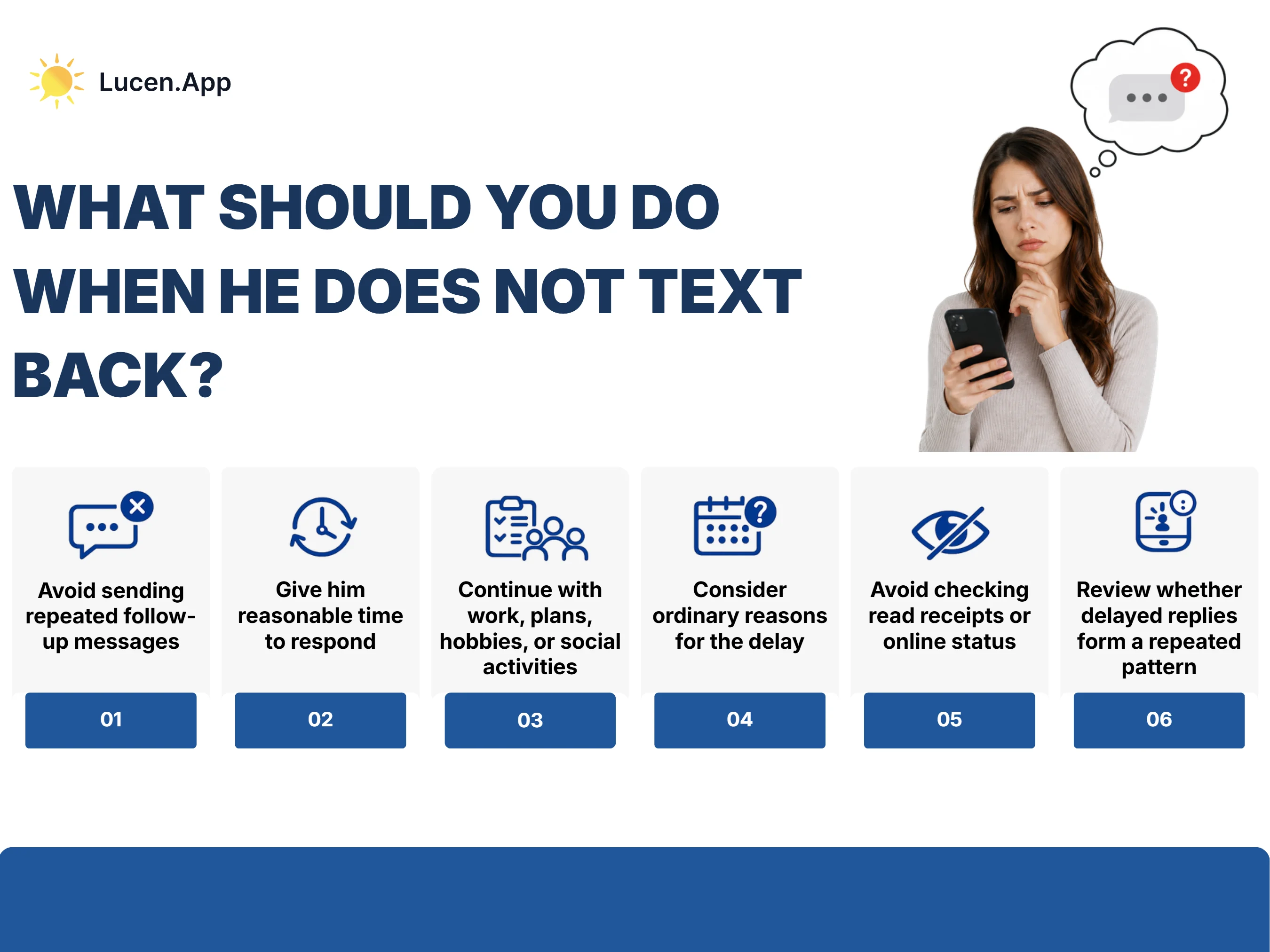
When he does not text back, you should avoid impulsive follow-up messages, allow reasonable time, stay engaged with your routine, consider everyday reasons for the delay, avoid monitoring digital activity, and evaluate repeated communication patterns instead of one unanswered text. A delayed reply provides limited information on its own. Viewing the situation through context rather than immediate emotion helps prevent uncertainty from becoming unsupported conclusions about the relationship.
The following points explain how to handle an unanswered text:
Avoid Sending Repeated Follow-Up Messages
Resist the urge to send another message immediately after an unanswered text. Double texting rarely provides additional clarity and often reflects uncertainty rather than new communication. One unanswered message only confirms that a reply has not arrived yet, leaving the reason for the delay unknown until further communication provides more context.
Give Him Reasonable Time to Respond
Allow enough time before deciding what the silence means. A delayed reply only confirms that more time has passed since the conversation paused. Daily responsibilities, different texting habits, or limited availability can influence response timing without revealing another person's level of interest, commitment, or emotional intention.
Continue with Work, Plans, Hobbies, or Social Activities
Return your attention to your daily routine instead of waiting around for a reply. Staying engaged with work, hobbies, plans, or friends prevents one unanswered message from dominating your thoughts. Keeping your normal routine also helps maintain perspective while additional communication or clearer context has time to develop naturally.
Consider Ordinary Reasons for the Delay
Think about everyday situations before assuming the worst. Work commitments, family responsibilities, travel, meetings, poor signal, or personal downtime can interrupt texting without reflecting changing feelings. One unanswered message provides very little information on its own, making ordinary explanations equally possible until further communication offers additional context.
Avoid Checking Read Receipts or Online Status
Stop refreshing read receipts or checking online status for reassurance. Those features only reveal limited phone activity rather than complete communication context. Constant monitoring encourages more interpretation without providing reliable evidence about another person's thoughts, priorities, availability, or intentions, making uncertainty feel more significant than the available information supports.
Review Whether Delayed Replies Form a Repeated Pattern
Look at the overall communication pattern instead of judging one unanswered message. Repeated interactions reveal consistency, mutual effort, and reliability more accurately than isolated delays. One unanswered text reflects a single moment, while recurring communication patterns provide stronger context for understanding how the connection develops over time.
How Should You Handle Mixed or Inconsistent Texting?
You should handle mixed or inconsistent texting by comparing messages with actions, looking for patterns across conversations, avoiding conclusions based on one vague text, noticing repeated changes in effort, asking for clarity when confusion continues, discussing communication expectations, and evaluating whether interactions remain respectful over time. One conversation rarely explains a relationship. Consistent communication and observable behavior provide stronger evidence than isolated messages, helping reduce assumptions created by uncertainty.
To handle mixed or inconsistent texting, consider these key points:
Compare His Messages with His Actions
Compare what he says with what he consistently does before drawing conclusions about the relationship. Words provide one part of communication, while actions reveal whether intentions remain consistent over time. Looking at both together creates a more reliable picture than relying on texts alone, especially when individual messages feel unclear or emotionally significant.
Look for Patterns Across Several Conversations
Evaluate communication across multiple conversations instead of relying on one interaction. One delayed reply, brief message, or missed conversation provides limited information on its own. Repeated communication patterns reveal consistency, mutual effort, and reliability more clearly, making it easier to distinguish temporary changes from ongoing inconsistency.
Avoid Assigning Fixed Meaning to One Vague Message
Treat one unclear message as limited information rather than a complete explanation. A vague text may create uncertainty, but it rarely confirms another person's feelings, priorities, or intentions by itself. Judging the relationship through one message increases assumptions while reducing attention to the broader communication pattern.
Notice Whether His Effort Changes Without Explanation
Pay attention to whether communication effort changes consistently over time. Occasional differences in texting can reflect everyday circumstances rather than relationship problems. A repeated decline in responsiveness, engagement, or follow-through provides more meaningful context than one isolated change, making long-term behavior more useful than single conversations.
Ask for Clarity When Confusion Becomes Repeated
Seek clarification when the same communication concerns continue across several interactions. Ongoing uncertainty becomes more meaningful when confusion remains unresolved despite repeated conversations. Requesting clarification creates an opportunity to understand expectations directly instead of relying on assumptions built from incomplete texting patterns.
Discuss Communication Expectations When Needed
Have an open conversation about communication preferences when different expectations create ongoing confusion. People often have different texting habits, response times, and communication styles. Discussing those differences directly provides a clearer understanding than interpreting repeated uncertainty through individual messages or changing response patterns.
Decide Whether His Communication Feels Clear and Respectful
Judge the relationship by whether communication remains consistent, respectful, and understandable over time. Healthy communication supports reliability, mutual effort, and reasonable clarity across repeated interactions. Looking at the overall experience instead of isolated texts creates a stronger basis for evaluating the connection than relying on assumptions from individual messages.
How Can You Stop Overthinking During the Talking Stage?
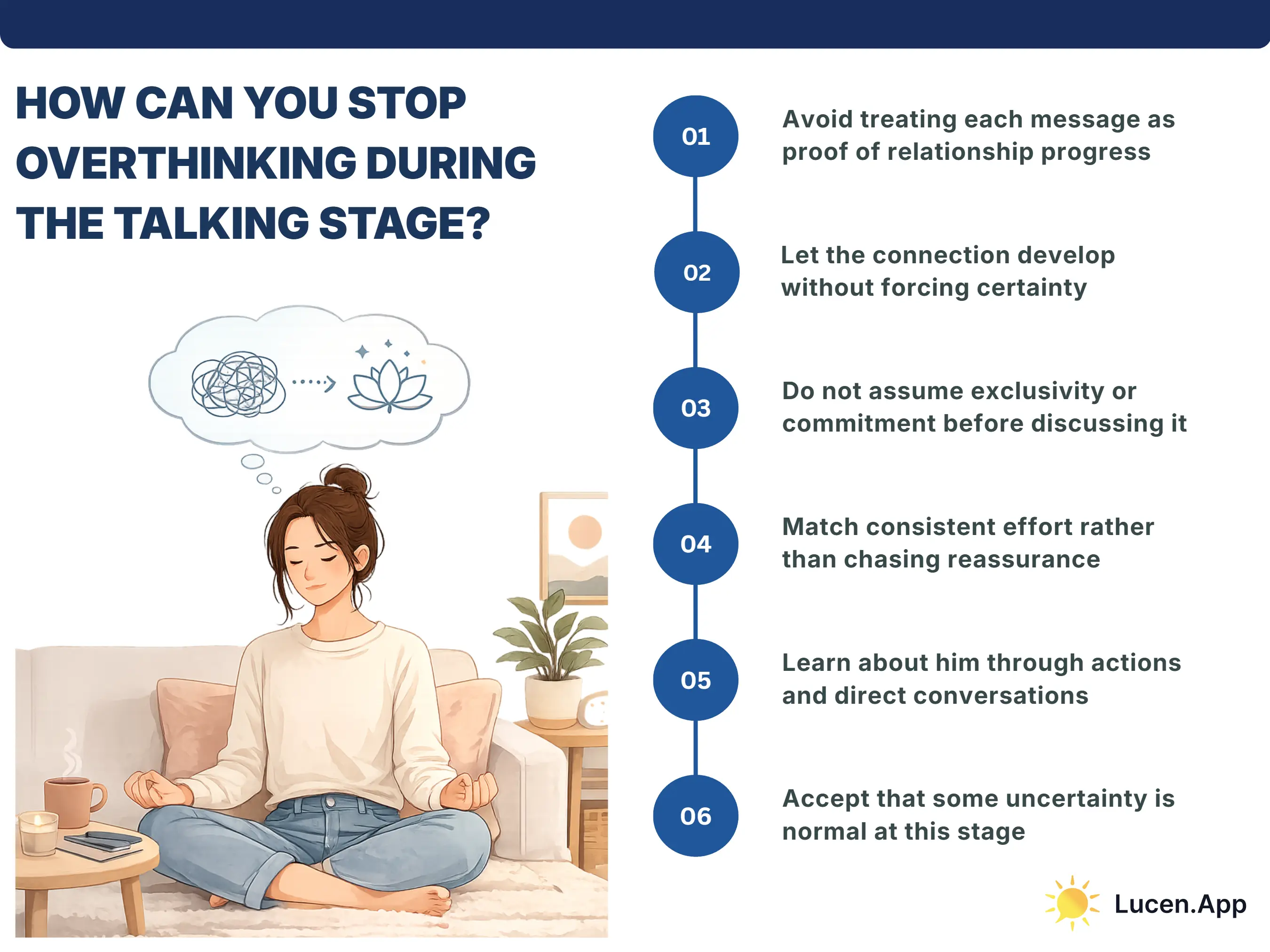
You can stop overthinking during the talking stage by avoiding conclusions from individual messages, letting the connection develop naturally, waiting for direct conversations about commitment, matching consistent effort, learning through actions and communication, and accepting normal uncertainty. Early dating rarely provides complete clarity. Giving the relationship time to develop and evaluating consistent behavior instead of isolated texts creates a more balanced understanding while reducing assumptions about where the connection is heading.
Avoid Treating Each Message as Proof of Relationship Progress
Treat each message as one part of the conversation rather than proof of where the relationship stands. A warm text, delayed reply, or thoughtful response reflects one interaction, not the entire connection. Relationship progress becomes clearer through repeated communication, shared experiences, and consistent behavior instead of isolated texting moments.
Let the Connection Develop Without Forcing Certainty
Allow the connection to develop at its own pace instead of seeking immediate certainty. Early conversations naturally contain unanswered questions because both people are still learning about each other. Giving the relationship time to unfold creates space for genuine communication and observable patterns to emerge before drawing lasting conclusions.
Do Not Assume Exclusivity or Commitment Before Discussing It
Wait for direct conversations before treating the relationship as exclusive or committed. Texting frequency, affectionate messages, or regular conversations do not automatically define relationship status. Clear expectations develop through open discussions, making direct communication a more reliable guide than personal assumptions about where the connection is heading.
Match Consistent Effort Rather Than Chasing Reassurance
Respond to the level of consistent effort you receive instead of seeking constant reassurance. Balanced communication develops when both people contribute naturally over time. Matching mutual effort provides a clearer picture of the connection than increasing messages or attention in response to temporary uncertainty during the talking stage.
Learn About Him Through Actions and Direct Conversations
Build your understanding through his actions and honest conversations rather than texting alone. Messages reveal only part of how someone communicates, while follow-through, reliability, and real conversations provide additional context. Looking at both words and behavior creates a stronger foundation for understanding the connection than interpreting individual texts.
Accept That Some Uncertainty Is Normal at This Stage
Accept that some uncertainty is a natural part of the talking stage. Early connections develop gradually, leaving many questions unanswered until more time and shared experiences provide context. Allowing uncertainty to exist without demanding immediate answers reduces overthinking and keeps expectations aligned with how relationships naturally progress.
What Healthy Texting Habits Can Prevent Overthinking?
Prevent overthinking by sending clear messages, replying when available instead of following timing games, avoiding repeated checking, keeping serious conversations out of text, discussing communication preferences, asking direct questions, and maintaining a balanced life outside dating. Healthy texting habits create clearer communication while reducing anxiety-driven behaviors. Responding to context instead of fear encourages more natural conversations and helps prevent ordinary texting situations from becoming emotionally overwhelming.
Below are the texting habits that can prevent overthinking:
Send Clear and Natural Messages
Write messages that are clear, direct, and genuine instead of trying to sound perfect. Simple communication leaves less room for misunderstanding than vague or overly edited responses. Expressing your thoughts naturally encourages more authentic conversations and reduces the tendency to overthink every word before or after sending a text.
Reply When Available Rather Than Following Timing Games
Reply when it feels appropriate instead of following artificial texting rules. Waiting a specific number of minutes or hours to appear less interested shifts attention away from genuine communication. Responding according to your availability creates more natural conversations and reduces anxiety caused by trying to manage impressions through timing.
Avoid Repeatedly Checking Read Receipts or Online Status
Limit how often you check read receipts or online status during conversations. Those features provide only limited information about phone activity, not someone's thoughts or intentions. Repeated monitoring encourages overthinking by keeping attention fixed on uncertainty instead of allowing communication to unfold naturally.
Keep Serious Conversations Out of Unclear Text Exchanges
Move important conversations beyond text when the topic requires clarity or emotional understanding. Complex discussions often lose important context through written messages alone. Talking by phone or in person provides tone, facial expressions, and immediate clarification, reducing misunderstandings that can develop during lengthy text exchanges.
Discuss Communication Preferences as the Relationship Develops
Talk openly about communication preferences as the relationship becomes more established. People often have different expectations for texting frequency, response times, and preferred ways of staying connected. Discussing those preferences directly creates shared understanding and reduces uncertainty caused by differing communication habits.
Use Direct Questions Instead of Decoding Hidden Meanings
Ask straightforward questions instead of searching for hidden meanings in every message. Direct communication replaces guessing with clearer information when something feels confusing. Honest questions encourage mutual understanding and reduce the tendency to build assumptions from unclear wording, delayed replies, or incomplete conversations.
Maintain a Routine, Friendships, and Interests Outside Dating
Keep investing in your routine, friendships, hobbies, and personal interests while dating. A balanced life prevents one conversation from becoming the main source of emotional attention. Staying connected to different parts of your life supports healthier communication and reduces overthinking driven by constant focus on the relationship.
How Can You Help Someone Stop Overthinking Over Text?
Support someone who is overthinking text messages by validating their emotions, separating facts from assumptions, discouraging anxiety-driven habits, encouraging calm before replying, and promoting direct communication instead of speculation. Empathy helps people feel understood, while balanced conversations reduce the tendency to treat uncertainty as evidence or reinforce unproven conclusions.
To help reduce overthinking over text, consider the following points:
Validate the Feeling Without Confirming the Feared Meaning
Acknowledge that feeling worried after receiving a text or waiting for a reply is understandable without assuming the feared interpretation is true. Emotions are valid, but they are not evidence of another person's intentions or feelings.
Help Them Separate the Message from Their Assumptions
Focus on what the message actually says rather than the meaning you have added to it. Separating observable facts from personal assumptions reduces unnecessary worry and keeps your interpretation grounded in the available communication. An AI chat analyzer may help review the broader conversation pattern instead of relying on one message or an anxiety-driven interpretation.
Discourage Repeated Checking and Message Decoding
Avoid repeatedly rereading texts, checking online status, or searching for hidden meanings. These habits rarely provide new information and often reinforce overthinking, making uncertainty feel even more emotionally significant over time.
Suggest a Calming Activity Before They Reply
Pause before replying to an emotionally triggering message and do something calming, such as taking a short walk or practicing slow breathing. Responding after your emotions settle often leads to clearer and more thoughtful communication.
Encourage Direct Communication When Confusion Continues
If confusion continues across several conversations, encourage respectful and direct communication. Honest questions replace assumptions with clearer information, helping both people understand each other's intentions without relying on speculation or guesswork.